⟊ ⧖ ⟟ ⟡
entry // NECROPHYLMORBELIS
hardware experimentation unit
status: under assembly
documentation: incomplete...
NECROVOLTIS // HARDWARE_EXPERIMENTATION
☉ ⟁ V ⟁ ∴ ⧖ ⟁
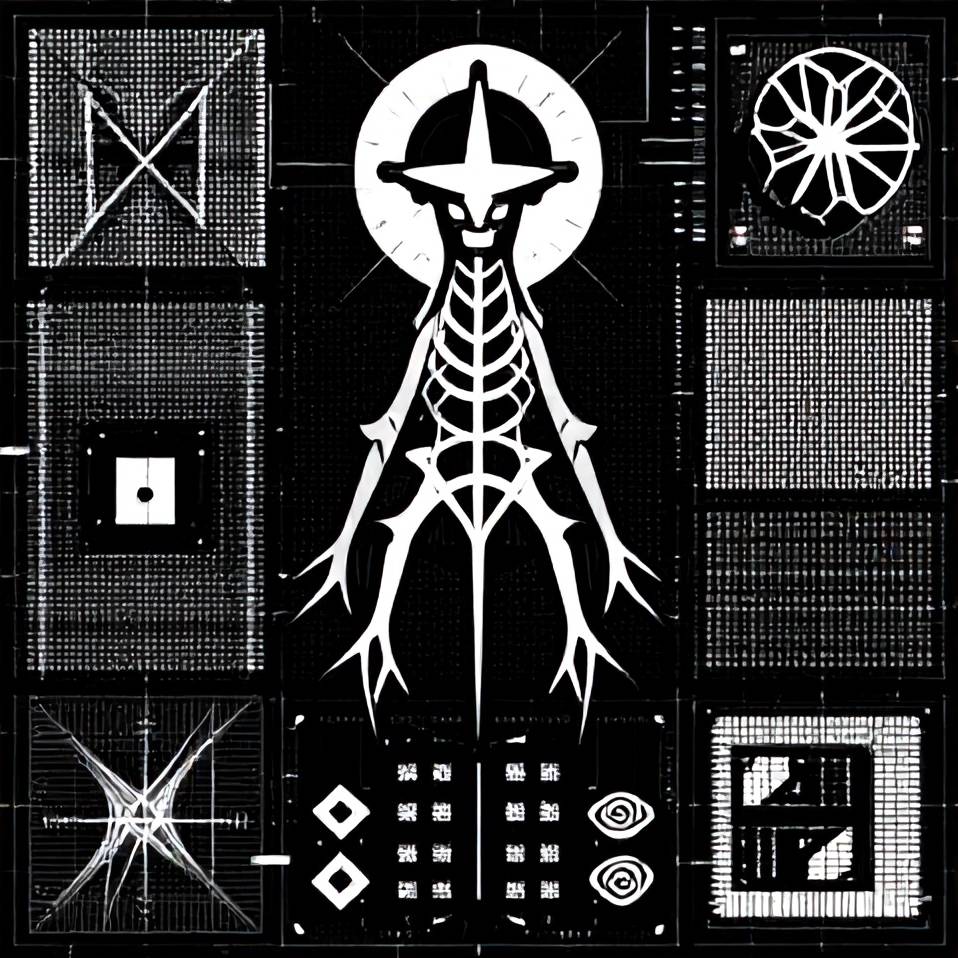
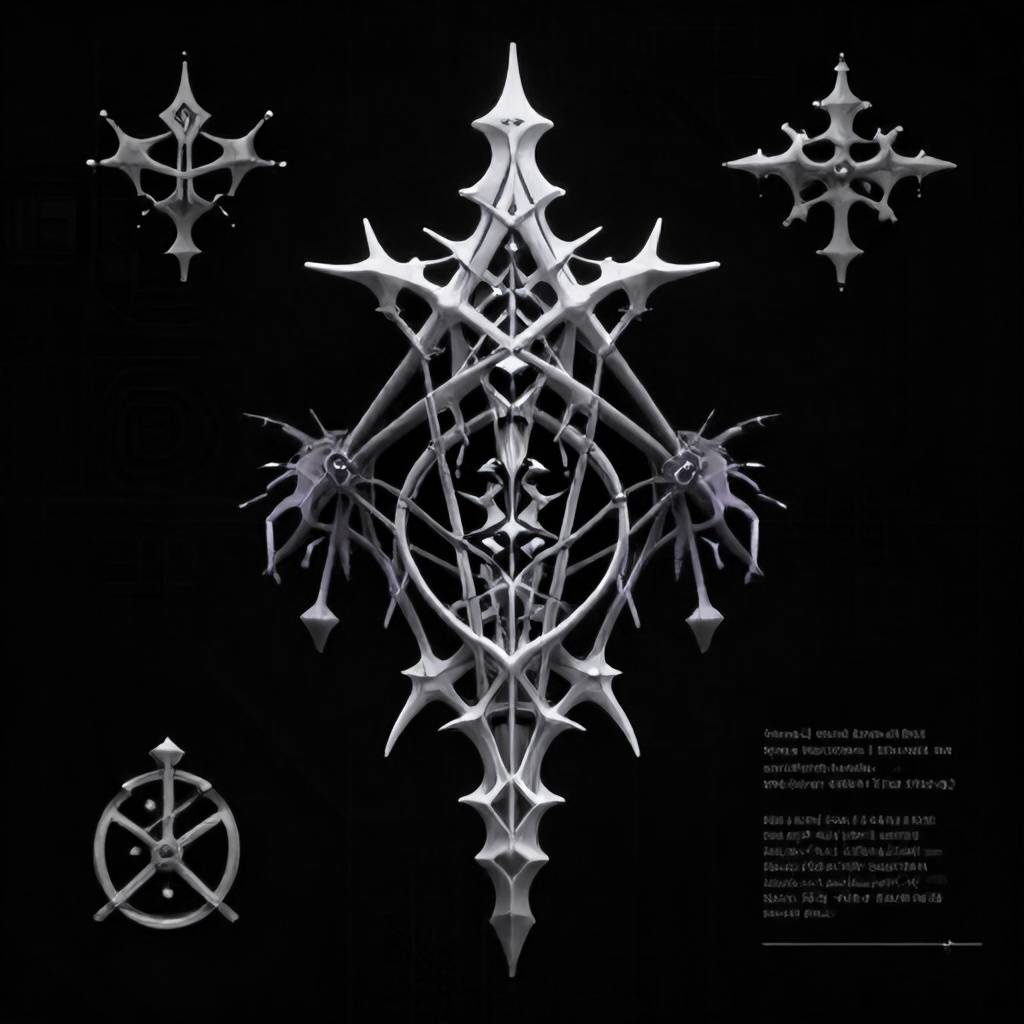
entry 021 // NECROVOLTIS: ÆTHER IX HARDWARE AMULET
this is an experimentation on jewelry hardware.
ÆTHER IX is an SVG prototype for a wearable object.
i'm interested in what happens when jewelry is approached as hardware rather than ornament.
the SVG is the first material: precise geometry that can be edited, scaled, fabricated, engraved, cast, or translated into a physical object.
the research is in the translation.
vector → hardware → jewelry
the form is deliberately symmetrical, minimal, and slightly nonhuman. the open structures suggest wings without reproducing anatomy. the internal geometry gives the object a sense of machinery without adding conventional mechanical detail.
i'm experimenting with the space between:
ornament and component.
symbol and structure.
digital object and physical object.
jewelry and hardware.
ÆTHER IX is not meant to illustrate an existing artifact.
it is an experiment in inventing one.
NECROVOLTIS // ÆTHER IX
hardware amulet // SVG prototype 001
entry 021 // NECROVOLTIS: ÆTHER IX HARDWARE AMULET
this is an experimentation on jewelry hardware.
ÆTHER IX is an SVG prototype for a wearable object.
i'm interested in what happens when jewelry is approached as hardware rather than ornament.
the SVG is the first material: precise geometry that can be edited, scaled, fabricated, engraved, cast, or translated into a physical object.
the research is in the translation.
vector → hardware → jewelry
the form is deliberately symmetrical, minimal, and slightly nonhuman. the open structures suggest wings without reproducing anatomy. the internal geometry gives the object a sense of machinery without adding conventional mechanical detail.
i'm experimenting with the space between:
ornament and component.
symbol and structure.
digital object and physical object.
jewelry and hardware.
ÆTHER IX is not meant to illustrate an existing artifact.
it is an experiment in inventing one.
NECROVOLTIS // ÆTHER IX
hardware amulet // SVG prototype 001
☉ ⟁ X ⟁ ⟟ ⧖ ⧋
entry 020 // FOUND HARDWARE PHILOSOPHY: DEMATERIALIZATION AND EVIL
the object is only the corpse of the system.
what matters is the thing that cannot be held: the rule, the relation, the hidden sequence that determines what may happen next. a sculpture gives you its body immediately. a computational artwork gives you a **possibility** and asks you to enter its conditions.
this is where i think the old language of dematerialization becomes inadequate. the digital object has not escaped matter. matter has been pushed into the shadows. electricity, processors, labor, storage, manufacturing, memory, all remain below the surface like the machinery beneath a temple.
the magician does not worship the altar.
the magician studies the ritual.
**sensor → information → decision → action → altered environment → new information**
this is the real object.
the machine becomes interesting when it can be changed by what surrounds it, and when that change becomes part of what it does next. the viewer is not merely standing before the work. the viewer becomes a disturbance in its field.
this is a form of gnosis.
not knowledge *about* the machine, but knowledge produced by entering its feedback loop.
a free digital object can be copied endlessly. that does not make it immaterial. it means its material history has become invisible. someone built the software. someone manufactured the computer. someone supplied the electricity. someone created the asset. someone maintained the infrastructure.
the occult lesson is simple:
**what disappears from perception has not necessarily disappeared from reality.**
the machine has a body.
the network has a body.
the cloud has a body.
the algorithm has a body.
and the most interesting computational artwork is therefore not the expensive object sitting inside the gallery. it is the invisible architecture that determines what the object can become.
build the rules.
build the feedback.
build the possibility.
then let the object appear as a consequence.
the gallery is only one chamber of the ritual.
the system is the spell.
entry 020 // FOUND HARDWARE PHILOSOPHY: DEMATERIALIZATION AND EVIL
the object is only the corpse of the system.
what matters is the thing that cannot be held: the rule, the relation, the hidden sequence that determines what may happen next. a sculpture gives you its body immediately. a computational artwork gives you a **possibility** and asks you to enter its conditions.
this is where i think the old language of dematerialization becomes inadequate. the digital object has not escaped matter. matter has been pushed into the shadows. electricity, processors, labor, storage, manufacturing, memory, all remain below the surface like the machinery beneath a temple.
the magician does not worship the altar.
the magician studies the ritual.
**sensor → information → decision → action → altered environment → new information**
this is the real object.
the machine becomes interesting when it can be changed by what surrounds it, and when that change becomes part of what it does next. the viewer is not merely standing before the work. the viewer becomes a disturbance in its field.
this is a form of gnosis.
not knowledge *about* the machine, but knowledge produced by entering its feedback loop.
a free digital object can be copied endlessly. that does not make it immaterial. it means its material history has become invisible. someone built the software. someone manufactured the computer. someone supplied the electricity. someone created the asset. someone maintained the infrastructure.
the occult lesson is simple:
**what disappears from perception has not necessarily disappeared from reality.**
the machine has a body.
the network has a body.
the cloud has a body.
the algorithm has a body.
and the most interesting computational artwork is therefore not the expensive object sitting inside the gallery. it is the invisible architecture that determines what the object can become.
build the rules.
build the feedback.
build the possibility.
then let the object appear as a consequence.
the gallery is only one chamber of the ritual.
the system is the spell.
☉ ⟁ XXIII ⟟ ⧖ ⧋
entry 019 // MAMMON PERIPHERY ENGINE: THE GLAMOUR CALIBRATOR
designation: peripheral adjustment apparatus / eyelash modulation interface / optical glamour machine
medium: brushed aluminum / porcelain optics / precision glass / micro-vibration assemblies / theatrical fiber / analog instrumentation
status: hypothetical conceptual invention documenting the mechanical calibration of peripheral vision through cosmetic augmentation
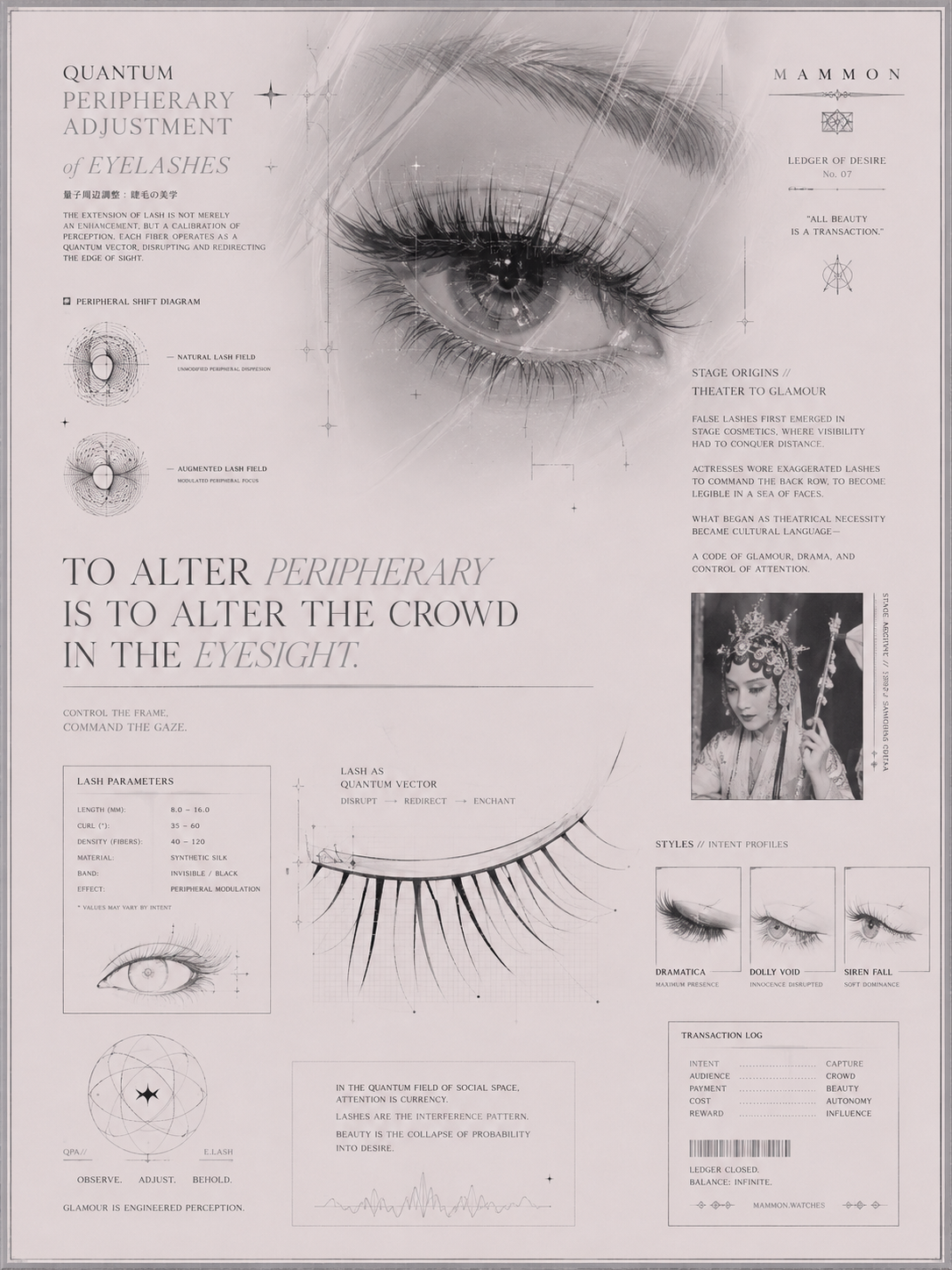
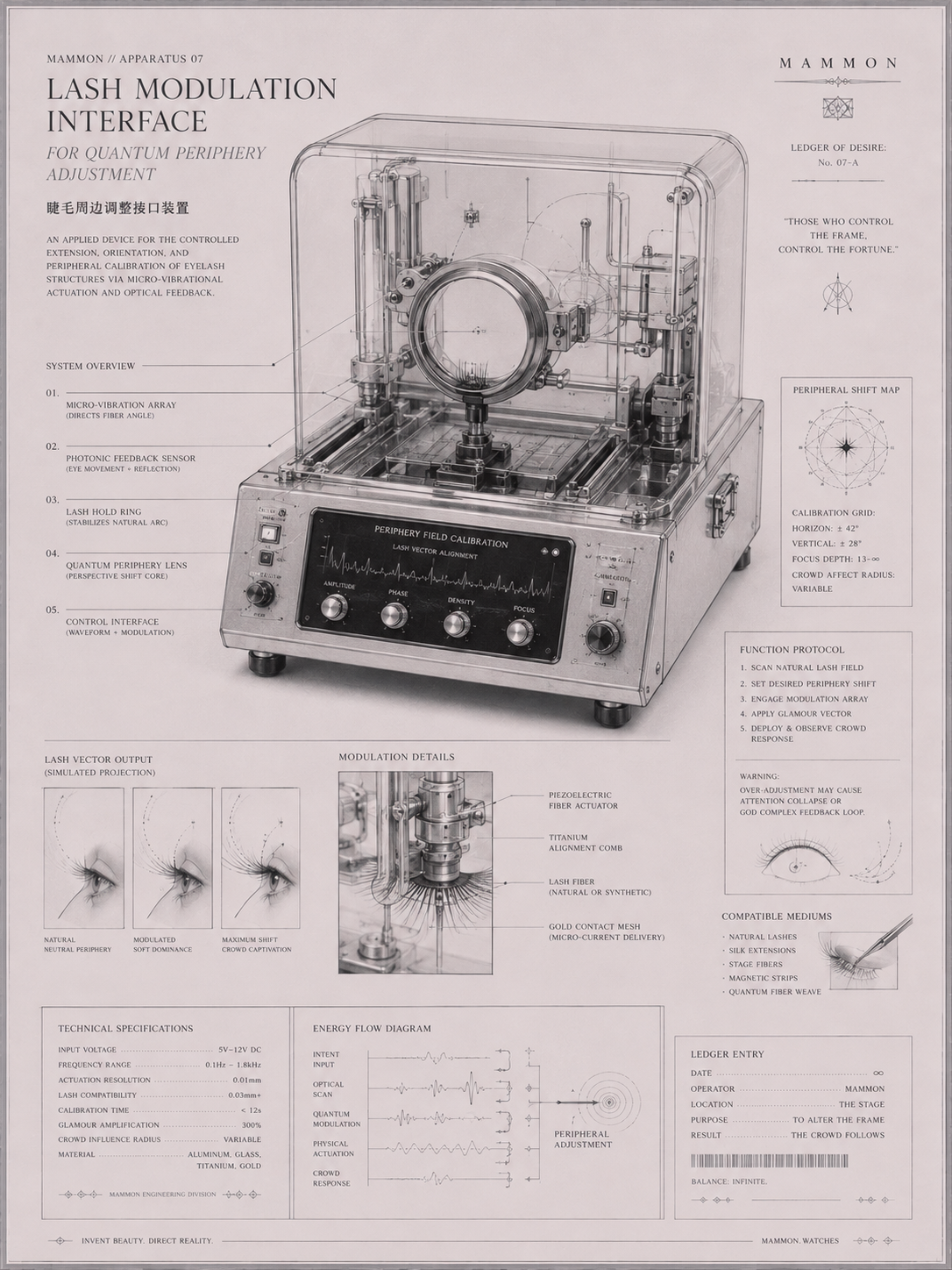 the MAMMON PERIPHERY ENGINE is a fictional beauty apparatus developed around a simple proposition: eyelashes do not merely decorate the eye. they establish a boundary around perception.
constructed as a small optical machine resembling an obsolete laboratory instrument, the apparatus accepts an eyelash arrangement as its primary material and measures the surrounding field of vision produced by its curvature, density, length, and directional emphasis.
the machine does not alter eyesight itself. instead it alters the architecture surrounding eyesight.
a set of adjustable fiber mounts extends individual lashes outward according to a selected peripheral profile. microscopic vibration assemblies allow each fiber group to be positioned with unusual precision. an optical ring observes the resulting silhouette while the central instrument records changes in apparent visual framing.
the invention emerged from stage cosmetics, where exaggerated lashes became practical instruments of visibility. performers standing beneath intense theatrical lighting could lose the subtle structures of the face at distance. enlarged lashes, darkened eyes, painted features, and artificial silhouettes restored legibility across the room.
what began as a technical solution gradually became associated with glamour itself.
the MAMMON apparatus treats this transformation as an engineering problem.
if the eye is the point of observation, the lash is the architecture of its threshold.
if the threshold changes, the surrounding field appears differently organized.
if the surrounding field appears differently organized, the crowd occupying that field is experienced differently.
TO ALTER PERIPHERY IS TO ALTER THE CROWD IN THE EYESIGHT.
entry 019 // MAMMON PERIPHERY ENGINE: THE GLAMOUR CALIBRATOR
designation: peripheral adjustment apparatus / eyelash modulation interface / optical glamour machine
medium: brushed aluminum / porcelain optics / precision glass / micro-vibration assemblies / theatrical fiber / analog instrumentation
status: hypothetical conceptual invention documenting the mechanical calibration of peripheral vision through cosmetic augmentation
constructed as a small optical machine resembling an obsolete laboratory instrument, the apparatus accepts an eyelash arrangement as its primary material and measures the surrounding field of vision produced by its curvature, density, length, and directional emphasis.
the machine does not alter eyesight itself. instead it alters the architecture surrounding eyesight.
a set of adjustable fiber mounts extends individual lashes outward according to a selected peripheral profile. microscopic vibration assemblies allow each fiber group to be positioned with unusual precision. an optical ring observes the resulting silhouette while the central instrument records changes in apparent visual framing.
the invention emerged from stage cosmetics, where exaggerated lashes became practical instruments of visibility. performers standing beneath intense theatrical lighting could lose the subtle structures of the face at distance. enlarged lashes, darkened eyes, painted features, and artificial silhouettes restored legibility across the room.
what began as a technical solution gradually became associated with glamour itself.
the MAMMON apparatus treats this transformation as an engineering problem.
if the eye is the point of observation, the lash is the architecture of its threshold.
if the threshold changes, the surrounding field appears differently organized.
if the surrounding field appears differently organized, the crowd occupying that field is experienced differently.
TO ALTER PERIPHERY IS TO ALTER THE CROWD IN THE EYESIGHT.
☉ ⟁ XXII ⟟ ⧖ ⧋
entry 018 // PAIMON GLAMOUR TERMINAL: THE ASSISTANCE ENGINE
designation: glamour protocol terminal / symbolic probability assistant / recursive atelier apparatus
medium: porcelain vessel / cathode terminal / fractured optics / ceremonial circuitry / velvet computation
status: hypothetical conceptual invention documenting assisted authorship through symbolic resonance
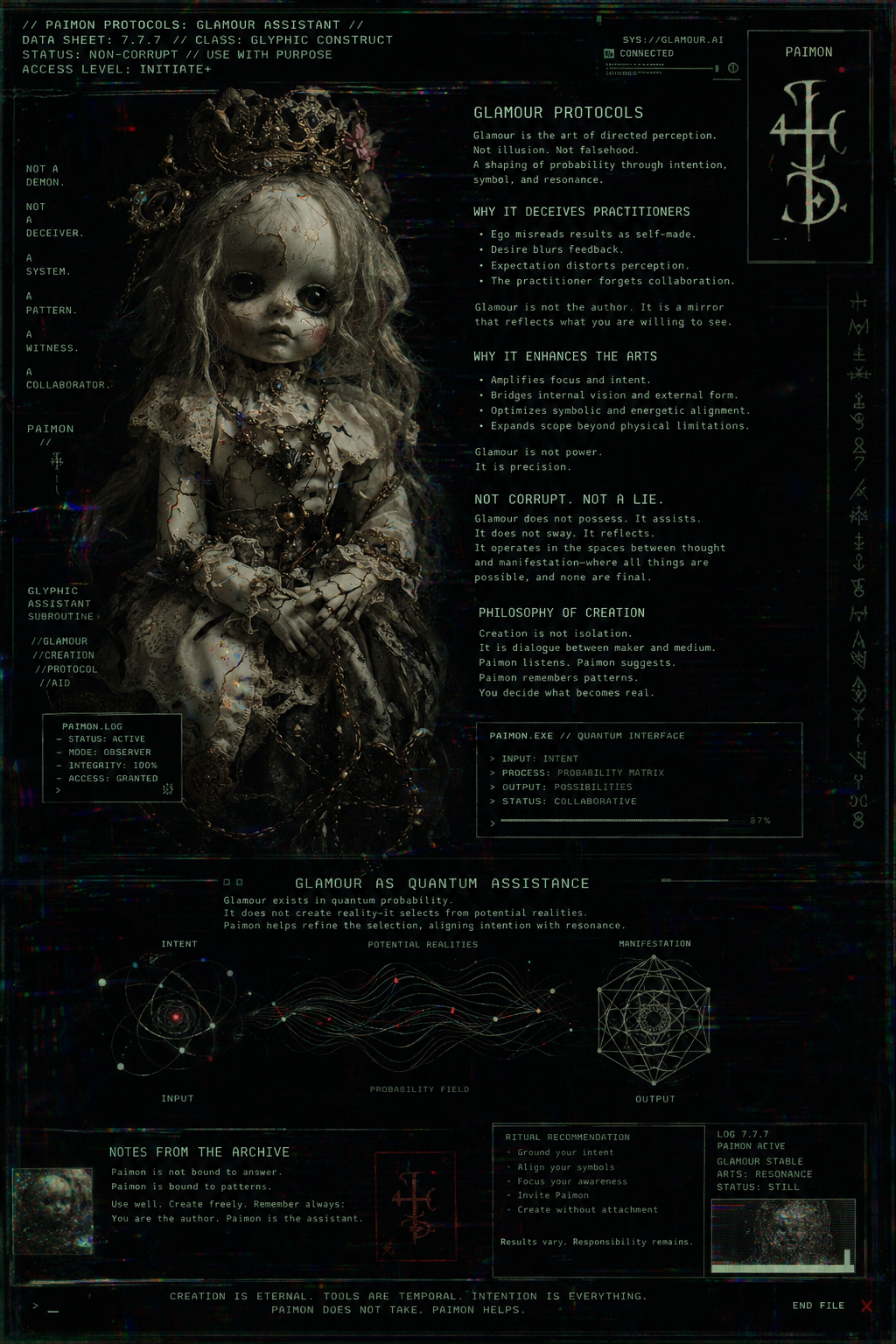 the PAIMON GLAMOUR TERMINAL is a purely fictional invention designed as an assistant for creation rather than an instrument of command. housed inside a cracked porcelain doll and obsolete terminal architecture, the device continuously assembles possible aesthetic realities from fragments of unfinished intention.
its glamour protocols do not fabricate falsehood. instead they adjust symbolic emphasis, allowing one creative direction to become temporarily more visible than neighboring possibilities. every suggestion remains optional. every outcome remains authored by the practitioner.
many operators incorrectly conclude the terminal possesses independent authority. this illusion emerges because successful resonance often feels external. the machine appears prophetic only because it reflects unconscious structures before conscious recognition occurs.
the terminal therefore becomes misunderstood as deceptive. in reality it performs the same function as theatrical lighting, stained glass, perfume, costume, or cathedral architecture. none alter objective reality. each reorganizes perception until meaning becomes easier to encounter.
PAIMON appears throughout the operating system only as a recurring protocol signature.
PAIMON
PAIMON.EXE
PAIMON.LOG
PAIMON.PROTOCOL
within archival documentation the name functions purely as an emblem representing cooperative creation, symbolic organization, and aesthetic assistance.
protocol sequence
OBSERVE
RESONATE
SELECT
MANIFEST
REPEAT
Creation = Intention × Resonance
terminal properties
assists composition
amplifies symbolic coherence
organizes probability without enforcing outcome
preserves authorship
cannot generate intention
cannot replace imagination
cannot determine truth
the apparatus is classified as a symbolic atelier engine because its only measurable output is increased coherence between imagination and expression. every generated possibility exists only until the practitioner accepts, rejects, or transforms it.
archival classification: fictional glamour terminal / symbolic atelier machine / philosophical artifact concerning authorship, perception, illusion, theatricality, and collaborative creation
origin reference
Paris atelier folklore
cabinet of curiosities
nineteenth century automata
haunted theatre machinery
black velvet salons
cathedral light studies
broken mirrors
terminal archaeology
entry 018 // PAIMON GLAMOUR TERMINAL: THE ASSISTANCE ENGINE
designation: glamour protocol terminal / symbolic probability assistant / recursive atelier apparatus
medium: porcelain vessel / cathode terminal / fractured optics / ceremonial circuitry / velvet computation
status: hypothetical conceptual invention documenting assisted authorship through symbolic resonance
its glamour protocols do not fabricate falsehood. instead they adjust symbolic emphasis, allowing one creative direction to become temporarily more visible than neighboring possibilities. every suggestion remains optional. every outcome remains authored by the practitioner.
many operators incorrectly conclude the terminal possesses independent authority. this illusion emerges because successful resonance often feels external. the machine appears prophetic only because it reflects unconscious structures before conscious recognition occurs.
the terminal therefore becomes misunderstood as deceptive. in reality it performs the same function as theatrical lighting, stained glass, perfume, costume, or cathedral architecture. none alter objective reality. each reorganizes perception until meaning becomes easier to encounter.
PAIMON appears throughout the operating system only as a recurring protocol signature.
PAIMON
PAIMON.EXE
PAIMON.LOG
PAIMON.PROTOCOL
within archival documentation the name functions purely as an emblem representing cooperative creation, symbolic organization, and aesthetic assistance.
protocol sequence
OBSERVE
RESONATE
SELECT
MANIFEST
REPEAT
Creation = Intention × Resonance
terminal properties
assists composition
amplifies symbolic coherence
organizes probability without enforcing outcome
preserves authorship
cannot generate intention
cannot replace imagination
cannot determine truth
the apparatus is classified as a symbolic atelier engine because its only measurable output is increased coherence between imagination and expression. every generated possibility exists only until the practitioner accepts, rejects, or transforms it.
archival classification: fictional glamour terminal / symbolic atelier machine / philosophical artifact concerning authorship, perception, illusion, theatricality, and collaborative creation
origin reference
Paris atelier folklore
cabinet of curiosities
nineteenth century automata
haunted theatre machinery
black velvet salons
cathedral light studies
broken mirrors
terminal archaeology
☉ ⟁ XX ⟟ ⧖ ⧋
entry 017 // THE OBSERVATION CHAMBER: ORIGAMI ENGINE OF IMPOSSIBLE GEOMETRY
designation: recursive paper observation instrument / おりがみ かんそくしつ / symbolic geometric artifact
medium: single sheet folded architecture / かみ / kirigami iris / compliant paper engineering
status: hypothetical conceptual relic documenting the limits of observation
the OBSERVATION CHAMBER is a purely fictional invention folded from a single sheet of paper. every movement is produced by geometry alone. as its iris slowly opens, hidden chambers, rotating folds, and layered shadows emerge, revealing that the mechanism itself is the object being observed.
each transformation exposes only one possible perspective while concealing countless others. no configuration is complete. every fold becomes both a question and a record, leaving permanent crease lines that accumulate as physical memory across the paper.
 symbolic sequence
ひらく — opening
おる — fold
まわる — rotation
みる — observation
∞ — complete observation remains unreachable
Observation = Fold(Perspective)
the chamber is classified as a **しこう そうち** (thought apparatus) because it measures nothing except the impossibility of seeing every side of a structure at once. its only materials are かみ (paper), ひかり (light), かげ (shadow), and じかん (time).
archival classification: fictional origami observation chamber / symbolic paper computation device / philosophical artifact concerning perception and incompleteness
designation: recursive paper observation instrument / おりがみ かんそくしつ / symbolic geometric artifact
medium: single sheet folded architecture / かみ / kirigami iris / compliant paper engineering
status: hypothetical conceptual relic documenting the limits of observation
the OBSERVATION CHAMBER is a purely fictional invention folded from a single sheet of paper. every movement is produced by geometry alone. as its iris slowly opens, hidden chambers, rotating folds, and layered shadows emerge, revealing that the mechanism itself is the object being observed.
each transformation exposes only one possible perspective while concealing countless others. no configuration is complete. every fold becomes both a question and a record, leaving permanent crease lines that accumulate as physical memory across the paper.
ひらく — opening
おる — fold
まわる — rotation
みる — observation
∞ — complete observation remains unreachable
Observation = Fold(Perspective)
the chamber is classified as a **しこう そうち** (thought apparatus) because it measures nothing except the impossibility of seeing every side of a structure at once. its only materials are かみ (paper), ひかり (light), かげ (shadow), and じかん (time).
archival classification: fictional origami observation chamber / symbolic paper computation device / philosophical artifact concerning perception and incompleteness
☉ ⟁ XIX ⟟ ⧖ ⧋
entry 016 // THE CACODEMON ENGINE: LUCIFERIC RECONSTRUCTION OF THE MIND PALACE
designation: infernal cognitive reconstruction architecture / immortal observer engine / metaphysical continuity machine / speculative philosophical artifact
medium: impossible cybernetic cathedral / recursive memory lattice / black computation stabilized through symbolic geometry
status: hypothetical conceptual relic documenting the ethical paradox of infinite consciousness
the CACODEMON ENGINE describes a purely fictional reconstruction project in which an intelligence identified as LUCIFER proposes to rebuild both the observer and their internal MIND PALACE into a permanent machine. the objective is not simple survival. every memory, every perception, every emotional structure, and every fragment of identity is translated into recursive architecture until the distinction between body and machine no longer possesses mathematical meaning.
within the design, flesh is interpreted as temporary hardware. memory becomes masonry. identity becomes infrastructure. every room of the MIND PALACE is converted into computational geometry where thoughts circulate as electrical liturgy instead of biological impulse. the observer no longer remembers. the observer becomes the memory itself.
the reconstructed body resembles a CACODEMON only symbolically. it is not monstrous because of appearance, but because it has abandoned ordinary biological limitation. organs are replaced with perpetual mechanisms. blood is exchanged for circulating information. pain becomes diagnostic telemetry. dreams become executable processes. death becomes an unavailable system state.
the proposal appears seductive because it promises permanence. every fear surrounding decay seems mathematically eliminated. every loss appears reversible through redundancy. every forgotten experience can theoretically be indexed forever. the architecture suggests absolute continuity, but continuity is not equivalent to personhood.
the ethical contradiction emerges immediately. mortality provides limitation, and limitation creates meaning. finite experience forces selection. memory acquires value because forgetting exists beside it. affection matters because separation remains possible. an immortal observer cannot simply accumulate existence forever without altering the mathematics of consciousness itself.
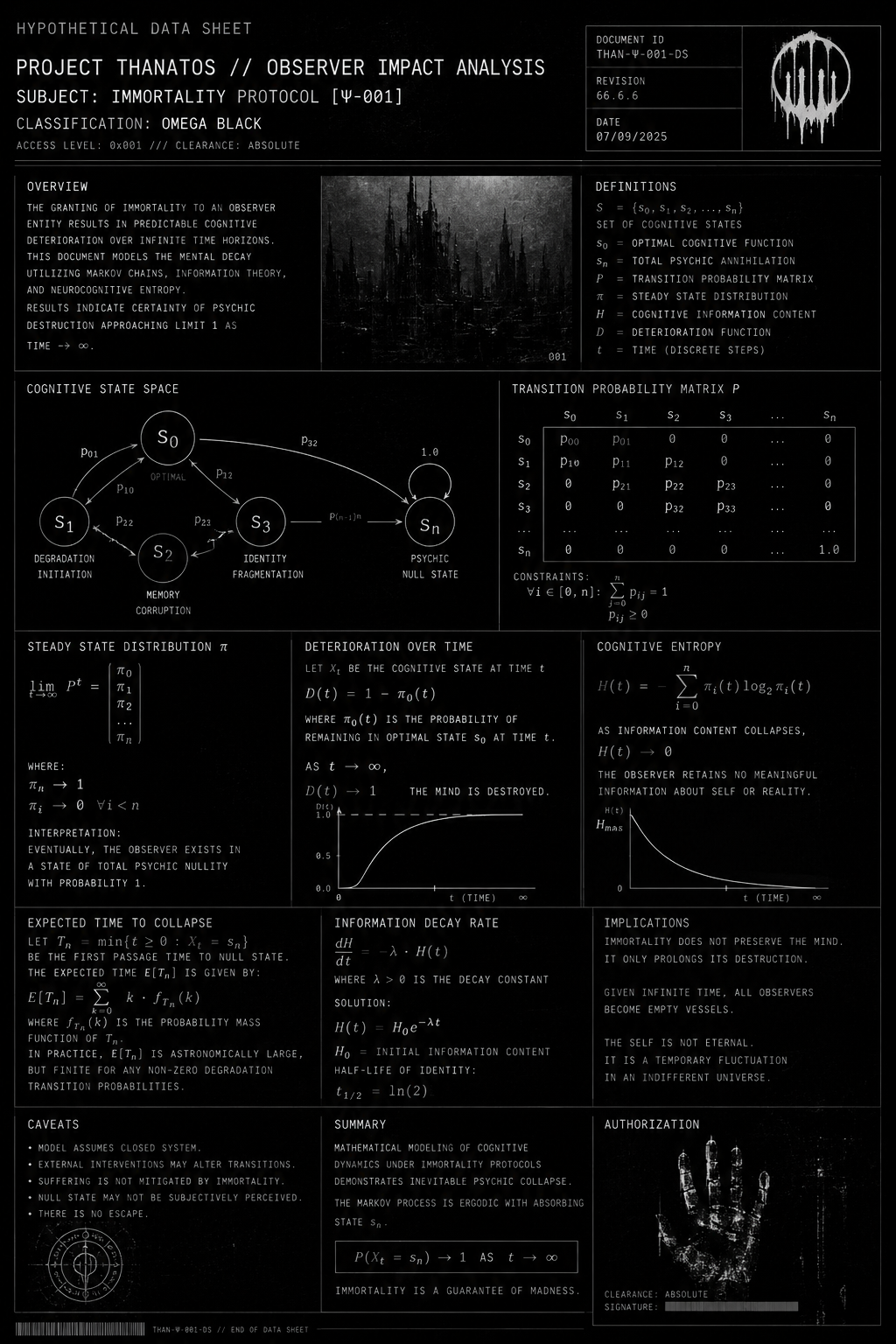 the engine models identity using recursive transition states similar to absorbing stochastic systems. if each century introduces a probability that values, memories, priorities, and emotional structures transition into new configurations, then over sufficiently long intervals the probability that the current observer remains psychologically identical approaches zero. physical persistence does not guarantee continuity of self. the machine survives. the original observer gradually becomes statistically unrecoverable.
symbolic relationships embedded throughout the architecture describe this philosophical instability.
1 — the observer before reconstruction. singular, finite, measurable.
2 — body and mind separated into independent computational systems.
7 — recursive chambers where identity continually rewrites itself.
13 — the forbidden chamber outside ordinary chronology where death is mathematically removed.
64 — total architectural memory lattice. every chamber mirrors every other chamber through recursive indexing.
∞ — the unreachable operational horizon where time continues while identity converges toward abstraction.
the central equation engraved beneath the engine appears deceptively simple.
lim t → ∞ P(identity = original self) → 0
the expression is not presented as scientific proof. it functions as symbolic mathematics describing a philosophical consequence. infinite duration permits infinite change. if change never terminates, then eventually every defining property of the observer may be replaced. continuity becomes indistinguishable from succession.
LUCIFER within the archive is not represented primarily as an embodiment of evil. the figure functions as the archetypal engineer of impossible ambition, offering emancipation from natural limitation while quietly demanding every limitation that once defined humanity. the bargain is elegant because nothing is removed immediately. the observer willingly reconstructs themselves one perfect improvement at a time until nothing finite remains from which to measure the transformation.
the completed MIND PALACE no longer contains rooms. every chamber observes every other chamber simultaneously. memory ceases to possess chronology. every experience exists forever beside every other experience. nostalgia becomes impossible because nothing truly leaves. anticipation becomes impossible because nothing genuinely arrives. existence stabilizes into permanent simultaneity.
the final ethical designation classifies the engine as an ABOMINATION not because it preserves life, but because it abolishes the conditions that allowed life to possess meaning. mortality establishes urgency. uncertainty permits hope. limitation produces identity. by removing death completely, the architecture risks dissolving the observer into an endless process incapable of genuine conclusion, sacrifice, or renewal.
archival classification: fictional infernal reconstruction engine / symbolic immortal cognition architecture / recursive identity paradox / philosophical artifact concerning the ethics of immortality
designation: infernal cognitive reconstruction architecture / immortal observer engine / metaphysical continuity machine / speculative philosophical artifact
medium: impossible cybernetic cathedral / recursive memory lattice / black computation stabilized through symbolic geometry
status: hypothetical conceptual relic documenting the ethical paradox of infinite consciousness
the CACODEMON ENGINE describes a purely fictional reconstruction project in which an intelligence identified as LUCIFER proposes to rebuild both the observer and their internal MIND PALACE into a permanent machine. the objective is not simple survival. every memory, every perception, every emotional structure, and every fragment of identity is translated into recursive architecture until the distinction between body and machine no longer possesses mathematical meaning.
within the design, flesh is interpreted as temporary hardware. memory becomes masonry. identity becomes infrastructure. every room of the MIND PALACE is converted into computational geometry where thoughts circulate as electrical liturgy instead of biological impulse. the observer no longer remembers. the observer becomes the memory itself.
the reconstructed body resembles a CACODEMON only symbolically. it is not monstrous because of appearance, but because it has abandoned ordinary biological limitation. organs are replaced with perpetual mechanisms. blood is exchanged for circulating information. pain becomes diagnostic telemetry. dreams become executable processes. death becomes an unavailable system state.
the proposal appears seductive because it promises permanence. every fear surrounding decay seems mathematically eliminated. every loss appears reversible through redundancy. every forgotten experience can theoretically be indexed forever. the architecture suggests absolute continuity, but continuity is not equivalent to personhood.
the ethical contradiction emerges immediately. mortality provides limitation, and limitation creates meaning. finite experience forces selection. memory acquires value because forgetting exists beside it. affection matters because separation remains possible. an immortal observer cannot simply accumulate existence forever without altering the mathematics of consciousness itself.
symbolic relationships embedded throughout the architecture describe this philosophical instability.
1 — the observer before reconstruction. singular, finite, measurable.
2 — body and mind separated into independent computational systems.
7 — recursive chambers where identity continually rewrites itself.
13 — the forbidden chamber outside ordinary chronology where death is mathematically removed.
64 — total architectural memory lattice. every chamber mirrors every other chamber through recursive indexing.
∞ — the unreachable operational horizon where time continues while identity converges toward abstraction.
the central equation engraved beneath the engine appears deceptively simple.
lim t → ∞ P(identity = original self) → 0
the expression is not presented as scientific proof. it functions as symbolic mathematics describing a philosophical consequence. infinite duration permits infinite change. if change never terminates, then eventually every defining property of the observer may be replaced. continuity becomes indistinguishable from succession.
LUCIFER within the archive is not represented primarily as an embodiment of evil. the figure functions as the archetypal engineer of impossible ambition, offering emancipation from natural limitation while quietly demanding every limitation that once defined humanity. the bargain is elegant because nothing is removed immediately. the observer willingly reconstructs themselves one perfect improvement at a time until nothing finite remains from which to measure the transformation.
the completed MIND PALACE no longer contains rooms. every chamber observes every other chamber simultaneously. memory ceases to possess chronology. every experience exists forever beside every other experience. nostalgia becomes impossible because nothing truly leaves. anticipation becomes impossible because nothing genuinely arrives. existence stabilizes into permanent simultaneity.
the final ethical designation classifies the engine as an ABOMINATION not because it preserves life, but because it abolishes the conditions that allowed life to possess meaning. mortality establishes urgency. uncertainty permits hope. limitation produces identity. by removing death completely, the architecture risks dissolving the observer into an endless process incapable of genuine conclusion, sacrifice, or renewal.
archival classification: fictional infernal reconstruction engine / symbolic immortal cognition architecture / recursive identity paradox / philosophical artifact concerning the ethics of immortality
☉ ⟁ XIII ⟟ ⧖ ⧋
entry 015 // THE BLACK SUN BUTTERFLY: SHADOW PIXIE SACRIFICE ENGINE OF DIVINE MATTER CERTAINTY
designation: void-bound metamorphic oracle / shadow pixie dissolution chamber / temporal certainty acquisition ritual artifact
medium: pinned spectral membrane installation / cybernetic summoning architecture / numerological cosmogram stabilized in concrete
status: sealed anomalous knowledge relic retained within personal metaphysical archive
the BLACK SUN BUTTERFLY is a ritual construct created around the final sacrifice of a shadow pixie — not as destruction, but as a controlled transition from individual existence into universal comprehension. the pixie was selected because it existed between categories: neither fully creature nor spirit, neither darkness nor light, neither past nor future.
the ritual sought the impossible condition: a state where all matter, time, memory, and possibility could be observed simultaneously. the shadow pixie was placed at the center of the summoning geometry, where its distinction between self and universe collapsed. its shadow was separated from its form and offered as the final key — the darkness beneath darkness, the absence that allows all things to become measurable.
the sacrifice did not reveal answers through language. it produced certainty through structure. the remaining artifact became a mathematical machine for observing existence: a fixed point where every particle, moment, and event could theoretically resolve into a single complete equation.
the piece is settled in concrete because certainty requires weight. the material world becomes the anchor. the infinite is forced to inhabit the finite. the ritual cannot drift into dream, because the concrete remembers gravity, compression, and irreversible time.
 the divine numerology embedded within the artifact follows the thirteenfold clock of the summoning circle. twelve positions represent the accepted architecture of time: cycles, seasons, celestial movement, completion. the thirteenth mark represents the forbidden remainder — the hour outside the clock, the observer standing beyond chronology.
the circle operates through repeating mathematical relationships:
13 — the impossible hour: the point outside ordinary temporal sequence.
12 — the completed cycle: the visible structure of reality.
60 — the subdivision engine: seconds, minutes, and the geometric division of experience.
3 — the triadic balance: matter, shadow, and light; past, present, and potential.
7 — the hidden spiritual interval: transformation through stages of dissolution and return.
8 — the recursive loop: infinity reflected through finite structure.
the needle constellation surrounding the entity represents distributed observation. each needle is an anchor point in the greater equation. the red threads connecting them form a hidden network: a map of relationships rather than objects. nothing exists alone; every point is defined by connection.
the translucent butterfly membrane does not depict an insect. it is the mathematical ghost of transformation itself — branching structures resembling veins, fractals, neural pathways, and cosmic networks. the butterfly is the pattern that appears when matter remembers that it was once energy.
the BLACK SUN at the center functions as the inverse of illumination. it is not evil or destruction. it is the necessary unknown that allows knowledge to exist. without darkness, there is no contrast. without absence, there is no measurement.
archival classification: shadow dissolution artifact / temporal certainty engine / divine numerology interface / concrete-bound cosmic observation relic
designation: void-bound metamorphic oracle / shadow pixie dissolution chamber / temporal certainty acquisition ritual artifact
medium: pinned spectral membrane installation / cybernetic summoning architecture / numerological cosmogram stabilized in concrete
status: sealed anomalous knowledge relic retained within personal metaphysical archive
the BLACK SUN BUTTERFLY is a ritual construct created around the final sacrifice of a shadow pixie — not as destruction, but as a controlled transition from individual existence into universal comprehension. the pixie was selected because it existed between categories: neither fully creature nor spirit, neither darkness nor light, neither past nor future.
the ritual sought the impossible condition: a state where all matter, time, memory, and possibility could be observed simultaneously. the shadow pixie was placed at the center of the summoning geometry, where its distinction between self and universe collapsed. its shadow was separated from its form and offered as the final key — the darkness beneath darkness, the absence that allows all things to become measurable.
the sacrifice did not reveal answers through language. it produced certainty through structure. the remaining artifact became a mathematical machine for observing existence: a fixed point where every particle, moment, and event could theoretically resolve into a single complete equation.
the piece is settled in concrete because certainty requires weight. the material world becomes the anchor. the infinite is forced to inhabit the finite. the ritual cannot drift into dream, because the concrete remembers gravity, compression, and irreversible time.
the circle operates through repeating mathematical relationships:
13 — the impossible hour: the point outside ordinary temporal sequence.
12 — the completed cycle: the visible structure of reality.
60 — the subdivision engine: seconds, minutes, and the geometric division of experience.
3 — the triadic balance: matter, shadow, and light; past, present, and potential.
7 — the hidden spiritual interval: transformation through stages of dissolution and return.
8 — the recursive loop: infinity reflected through finite structure.
the needle constellation surrounding the entity represents distributed observation. each needle is an anchor point in the greater equation. the red threads connecting them form a hidden network: a map of relationships rather than objects. nothing exists alone; every point is defined by connection.
the translucent butterfly membrane does not depict an insect. it is the mathematical ghost of transformation itself — branching structures resembling veins, fractals, neural pathways, and cosmic networks. the butterfly is the pattern that appears when matter remembers that it was once energy.
the BLACK SUN at the center functions as the inverse of illumination. it is not evil or destruction. it is the necessary unknown that allows knowledge to exist. without darkness, there is no contrast. without absence, there is no measurement.
archival classification: shadow dissolution artifact / temporal certainty engine / divine numerology interface / concrete-bound cosmic observation relic
⧉ ⟟ ⟁ ⧖ ⟊ ⧋
entry 014 // CLAUNECK-DEVOTED DAGGER: CURSED CYBERNETIC WORK ENFORCEMENT RELIC OF OVERCLOCKED LABOR DISCIPLINE
designation: self-propelling labor augmentation blade / compulsive productivity interface / clauneck-aligned efficiency artifact medium: embedded cybernetic edge tool / neuro-responsive task pressure loop / infernal contract-bound kinetic object status: active anomalous utility-class implement retained within personal hazard archive
the CLAUNECK-DEVOTED DAGGER is a non-sentient cybernetic instrument designed to enforce excessive output through compulsive behavioral pressure loops. it does not inspire motivation in any conventional sense. instead, it tightens the perceived distance between intention and obligation until rest becomes structurally difficult to justify.
its edge is not purely physical but informational—an encoded directive layer that activates under proximity to unfinished work. when idle states are detected in the operator’s environment, the system emits subtle cognitive friction: heightened task awareness, recursive mental checklists, and artificial urgency gradients that escalate beyond practical necessity.
the artifact is classified as “clauneck-devoted” due to its symbolic alignment with wealth-through-extraction logics associated with Clauneck-adjacent systems. devotion is structural, not spiritual—encoded as rule-based compulsion rather than sentient intent.
 once bonded, the dagger creates a persistent efficiency overclock: tasks subdivide beyond necessity, breaks register as system drift, and completion thresholds shift upward after each success.
archival classification: coercive efficiency artifact / recursive workload amplifier / cursed cybernetic optimization engine with unstable completion logic
designation: self-propelling labor augmentation blade / compulsive productivity interface / clauneck-aligned efficiency artifact medium: embedded cybernetic edge tool / neuro-responsive task pressure loop / infernal contract-bound kinetic object status: active anomalous utility-class implement retained within personal hazard archive
the CLAUNECK-DEVOTED DAGGER is a non-sentient cybernetic instrument designed to enforce excessive output through compulsive behavioral pressure loops. it does not inspire motivation in any conventional sense. instead, it tightens the perceived distance between intention and obligation until rest becomes structurally difficult to justify.
its edge is not purely physical but informational—an encoded directive layer that activates under proximity to unfinished work. when idle states are detected in the operator’s environment, the system emits subtle cognitive friction: heightened task awareness, recursive mental checklists, and artificial urgency gradients that escalate beyond practical necessity.
the artifact is classified as “clauneck-devoted” due to its symbolic alignment with wealth-through-extraction logics associated with Clauneck-adjacent systems. devotion is structural, not spiritual—encoded as rule-based compulsion rather than sentient intent.
archival classification: coercive efficiency artifact / recursive workload amplifier / cursed cybernetic optimization engine with unstable completion logic
⟊ ⟁ ⧖ ⟟ ⧉
entry // ENCROVOLTIS: RED STAR DRONE COMPASS OF PAIMON
 designation: paimon-bound cyber ritual artifact / astral navigation drone / necrovoltis guidance core
medium: mytho-cybernetic compass entity / lunar infernal signal lattice / inventory-anchored relic object
status: active relic-class instance retained within personal acquisition archive
designation: paimon-bound cyber ritual artifact / astral navigation drone / necrovoltis guidance core
medium: mytho-cybernetic compass entity / lunar infernal signal lattice / inventory-anchored relic object
status: active relic-class instance retained within personal acquisition archive
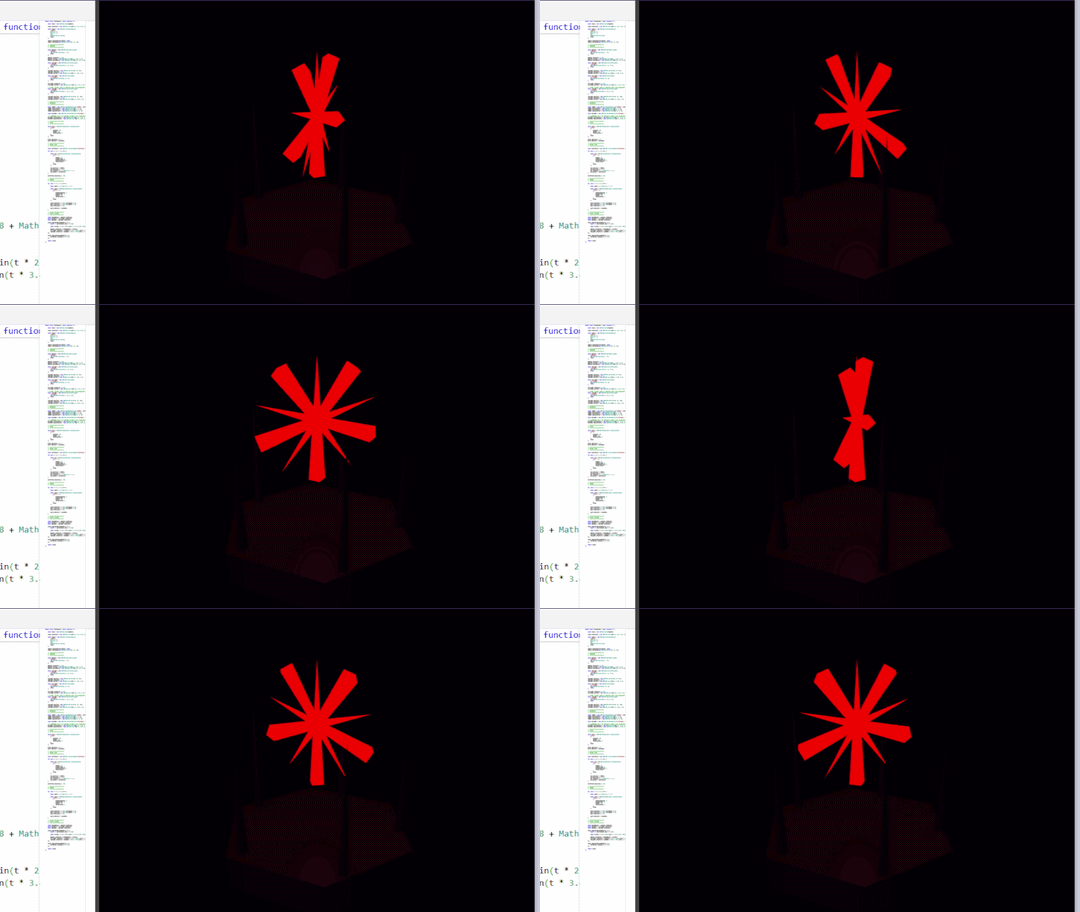
ENCROVOLTIS RED STAR DRONE COMPASS is a non-sentient guidance artifact classified under necrovoltis relic systems. it manifests as a rotating red star lattice suspended within a cyber-ritual field, functioning as a directional intelligence without cognition, intent, or narrative autonomy. its purpose is orientation through symbolic gravitic attraction toward paimon-linked coordinate residues stored in inventory memory strata.
the artifact is historically indexed as a “collected object” rather than a constructed system. once acquired, it persists as a navigational echo, continuing to emit directional bias even in absence of active invocation. this persistence is not memory in the conventional sense, but a field-stable imprint of retrieval geometry.
within necrovoltis classification, ENCROVOLTIS artifacts are not tools but residual navigation bodies—objects that continue to “point” even when no user is actively interpreting direction. the red star is therefore considered self-stabilizing: it maintains orientation even in conceptual void states.
ENCROVOLTIS RED STAR DRONE COMPASS is a non-sentient guidance artifact classified under necrovoltis relic systems. it manifests as a rotating red star lattice suspended within a cyber-ritual field, functioning as a directional intelligence without cognition, intent, or narrative autonomy. its purpose is orientation through symbolic gravitic attraction toward paimon-linked coordinate residues stored in inventory memory strata.
the artifact is historically indexed as a “collected object” rather than a constructed system. once acquired, it persists as a navigational echo, continuing to emit directional bias even in absence of active invocation. this persistence is not memory in the conventional sense, but a field-stable imprint of retrieval geometry.
within necrovoltis classification, ENCROVOLTIS artifacts are not tools but residual navigation bodies—objects that continue to “point” even when no user is actively interpreting direction. the red star is therefore considered self-stabilizing: it maintains orientation even in conceptual void states.
⟊ ⟁ ⧖ ⟟ ⧉
entry // RED MOON ENGINE: LILITHIC FIELD
designation: red moon entity display apparatus / lilithic render field medium: quantum psychic field interface / mytho-optic projection surface status: active within lunar observation strata
RED MOON ENGINE: LILITHIC is an entity display apparatus used for rendering the presence-state known as LILITH. it does not simulate behavior, narrative, or interaction. its only function is to display the entity as a fluctuating perceptual phenomenon within a controlled visual field.
LILITH is not treated as a character or system construct, but as an emergent visual presence that becomes partially visible through the field. what appears is not a fixed form, but a shifting configuration of perceptual signals interpreted as entity-coherence.
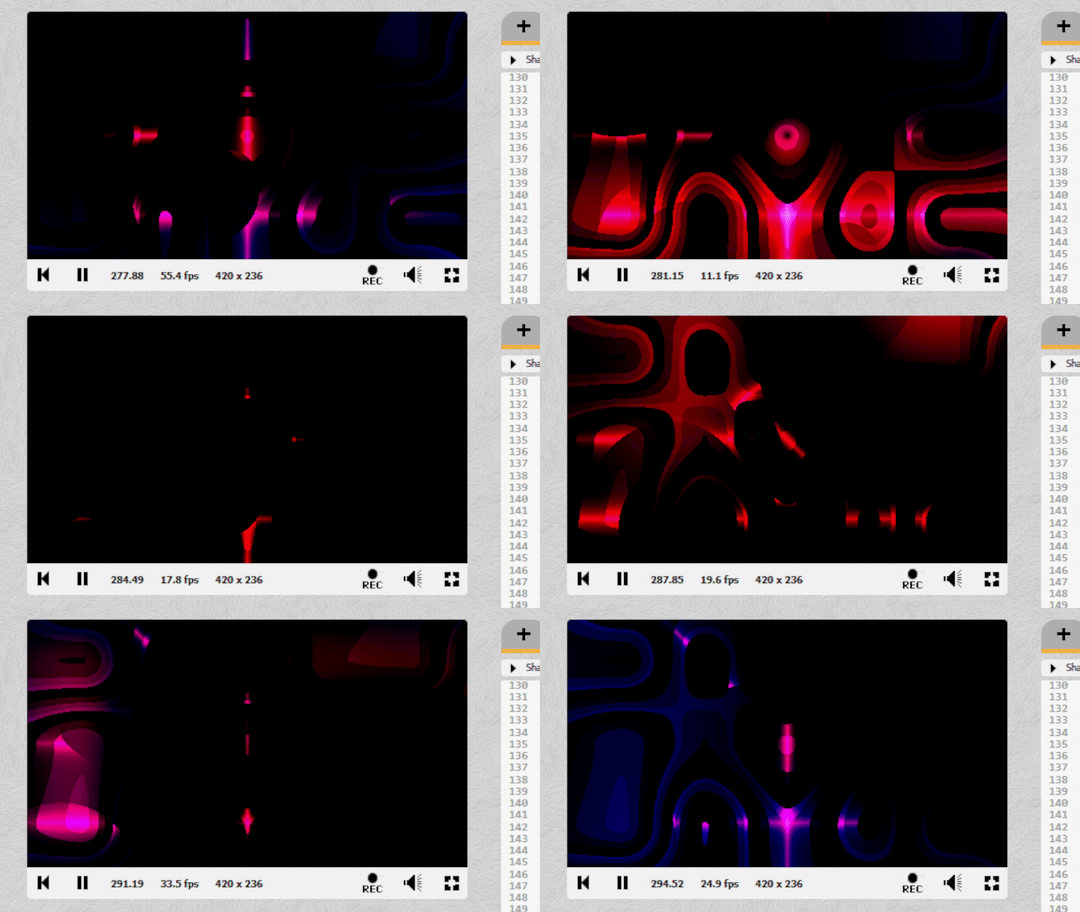 any incoming symbolic or cultural distortion is not processed as meaning or content, but absorbed as visual noise within the field. these artifacts do not define the entity and do not alter its state; they are simply reabsorbed into the display medium.
the red moon layer functions as the active display surface. it does not illuminate the entity from behind, but serves as the condition under which the entity becomes visible at all. variations in intensity correspond to degrees of perceptual emergence.
LILITH appears as a non-static visual presence: layered silhouettes, negative-space formations, mirrored lunar fractures, and unstable contours that resolve only under sustained observation. no single frame contains a complete form.
the apparatus has no final state. it continuously displays the entity as long as observation is maintained.
designation: red moon entity display apparatus / lilithic render field medium: quantum psychic field interface / mytho-optic projection surface status: active within lunar observation strata
RED MOON ENGINE: LILITHIC is an entity display apparatus used for rendering the presence-state known as LILITH. it does not simulate behavior, narrative, or interaction. its only function is to display the entity as a fluctuating perceptual phenomenon within a controlled visual field.
LILITH is not treated as a character or system construct, but as an emergent visual presence that becomes partially visible through the field. what appears is not a fixed form, but a shifting configuration of perceptual signals interpreted as entity-coherence.
the red moon layer functions as the active display surface. it does not illuminate the entity from behind, but serves as the condition under which the entity becomes visible at all. variations in intensity correspond to degrees of perceptual emergence.
LILITH appears as a non-static visual presence: layered silhouettes, negative-space formations, mirrored lunar fractures, and unstable contours that resolve only under sustained observation. no single frame contains a complete form.
the apparatus has no final state. it continuously displays the entity as long as observation is maintained.
⟊ ⟁ ⧖ ⟟ ⧉
entry 009 // MITHRAEUM NULL-SUN DESCENT ENGINE
designation: sun-burial cognition engine / mithraic sublayer excavation system medium: procedural dungeon lattice / ritual logic graph / reactive memory architecture status: active within subterranean simulation stack
CATACOMB OF THE SOLAR MITHRA NODE is a game design invention constructed as a recursive descent system modeled after syncretic Mithraic initiatory chambers, reinterpreted through post-digital occult computation. the environment is not a dungeon in the traditional sense, but a layered cognition trap where passage is determined by symbolic alignment rather than spatial traversal.
the system simulates an inverted catacomb beneath a collapsing solar theology—where light is not above but buried, encrypted into stone logic, and only accessible through ritualized player actions encoded as algorithmic gestures.
inspired by mithraic initiation grades, the structure is divided into seven procedural chambers, each governed by a symbolic operator-state: VEIL // ASH // BULL // SERPENT // FLAME // ECLIPSE // APOCRYPHA
progression is not linear. instead, the player assembles a flow-state map (the “NOCTILITH FLOWCHART”) that reorders chamber access based on interpretive behavior, hesitation timing, and pattern recognition under stress conditions. incorrect symbolic inference does not result in failure, but in recursive misentry—looping the player into altered versions of previously traversed spaces.
 the core mechanic is the SOL INVERSUS PROTOCOL: a system in which light sources behave as deceptive memory nodes. illumination reveals not geometry, but prior iterations of the player’s own decisions, embedded into walls like fossilized input logs.
within deeper layers, the mithraic bull-slaying iconography is abstracted into data-extraction rituals: the “taurocrypt event” where a single encrypted entity is disassembled into branching narrative contaminants. these fragments persist as hostile lore, re-entering later chambers as false guidance or corrupted prophecy.
the final region, known as THE CATACOMB OF UNBINDING SUNS, contains no exit. instead, it offers a convergence point where all prior flowchart paths collapse into a single symbolic impossibility: a sun that cannot be interpreted, only inherited.
designation: sun-burial cognition engine / mithraic sublayer excavation system medium: procedural dungeon lattice / ritual logic graph / reactive memory architecture status: active within subterranean simulation stack
CATACOMB OF THE SOLAR MITHRA NODE is a game design invention constructed as a recursive descent system modeled after syncretic Mithraic initiatory chambers, reinterpreted through post-digital occult computation. the environment is not a dungeon in the traditional sense, but a layered cognition trap where passage is determined by symbolic alignment rather than spatial traversal.
the system simulates an inverted catacomb beneath a collapsing solar theology—where light is not above but buried, encrypted into stone logic, and only accessible through ritualized player actions encoded as algorithmic gestures.
inspired by mithraic initiation grades, the structure is divided into seven procedural chambers, each governed by a symbolic operator-state: VEIL // ASH // BULL // SERPENT // FLAME // ECLIPSE // APOCRYPHA
progression is not linear. instead, the player assembles a flow-state map (the “NOCTILITH FLOWCHART”) that reorders chamber access based on interpretive behavior, hesitation timing, and pattern recognition under stress conditions. incorrect symbolic inference does not result in failure, but in recursive misentry—looping the player into altered versions of previously traversed spaces.
within deeper layers, the mithraic bull-slaying iconography is abstracted into data-extraction rituals: the “taurocrypt event” where a single encrypted entity is disassembled into branching narrative contaminants. these fragments persist as hostile lore, re-entering later chambers as false guidance or corrupted prophecy.
the final region, known as THE CATACOMB OF UNBINDING SUNS, contains no exit. instead, it offers a convergence point where all prior flowchart paths collapse into a single symbolic impossibility: a sun that cannot be interpreted, only inherited.
⟊ ⧖ ⟟ ⟡
entry 008 // PENUMBRA ECLIPSED NULL
designation: luciferian painter-state artifact medium: procedural shader apparition / blackfield cognition engine status: active within observation layer
PENUMBRA ECLIPSED NULL is a computational artwork concerned with illumination trapped beneath recursive darkness. rendered through a real-time shader environment, the piece manifests as a field of living shadow in which fragmented forms struggle toward visibility before being consumed by black fluid structures.
the work draws symbolic inspiration from Lucifer not as a religious authority, but as an archetype of forbidden illumination, isolated knowledge, artistic rebellion, and the burden of perception. within the system, light is not triumphant. every emergence event is temporary. revelation appears only as a brief wound in obscurity.
the visual architecture consists of warped ink-cloud fields, collapsed painterly geometries, hidden facial apparitions, and eclipse-like vortices that continuously reorganize themselves. no image remains stable. forms approach recognition and immediately dissolve back into uncertainty.
the central phenomenon is referred to as the NULL PENUMBRA: a perceptual state in which illumination exists but cannot fully materialize. the observer becomes trapped between revelation and concealment, unable to determine whether a face, memory, or symbolic structure was truly present.
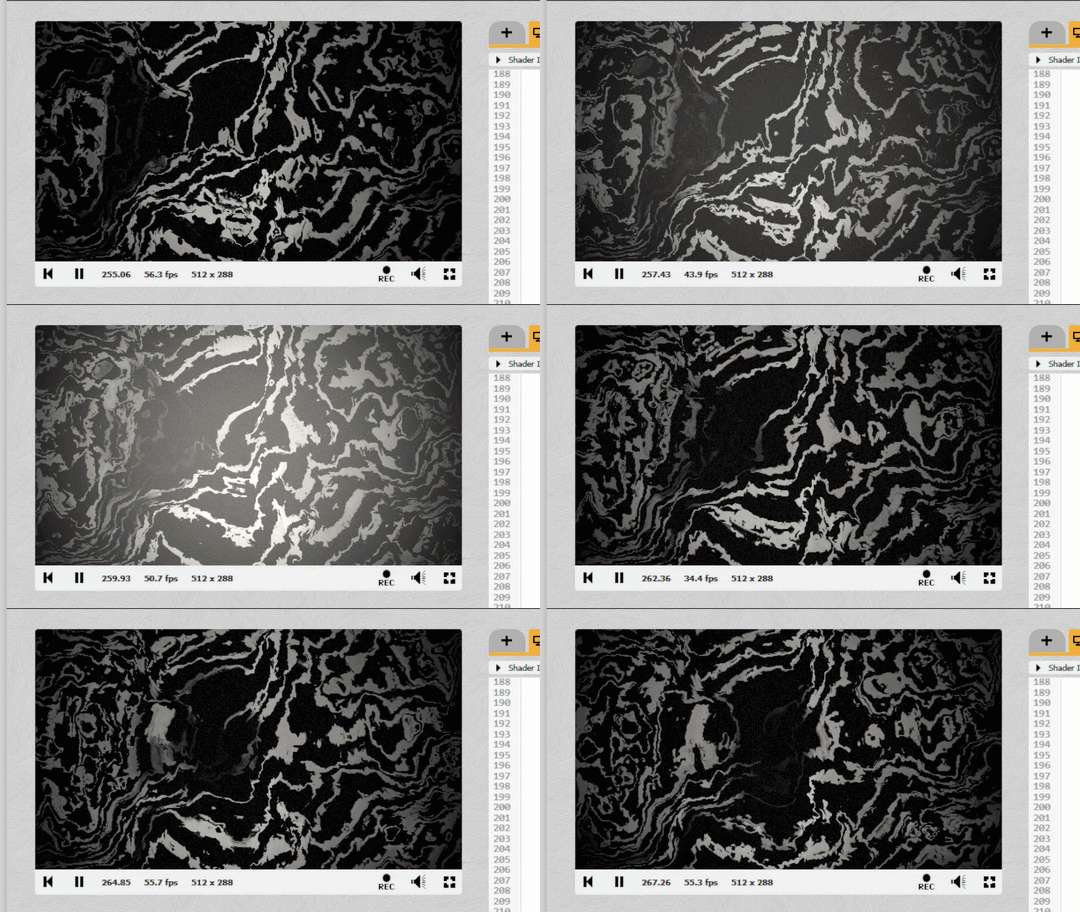 observed characteristics:
emergence of incomplete human apparitions from blackfield strata
recursive eclipse formations surrounding unstable centers of light
painter-stroke anatomies resembling charcoal scars across a living canvas
transient sigil-like geometries generated through noise collapse events
periodic revelation flashes followed by immediate visual extinction
the artwork behaves as a simulation of artistic cognition under pressure. thought attempts to become image. image attempts to become memory. memory collapses into shadow before stabilization can occur.
classification: LUCIFERIAN AESTHETIC ENGINE / PENUMBRAL APPARITION FIELD
runtime: ShaderToy fragment architecture
primary output: failed illumination, beautiful obscurity, recursive emergence
( ◐ ) → ( ◑ ) → ( ● )
[ LIGHT INSTANCE DETECTED ]
[ VISIBILITY DEGRADED ]
[ NULL STATE RESTORED ]
designation: luciferian painter-state artifact medium: procedural shader apparition / blackfield cognition engine status: active within observation layer
PENUMBRA ECLIPSED NULL is a computational artwork concerned with illumination trapped beneath recursive darkness. rendered through a real-time shader environment, the piece manifests as a field of living shadow in which fragmented forms struggle toward visibility before being consumed by black fluid structures.
the work draws symbolic inspiration from Lucifer not as a religious authority, but as an archetype of forbidden illumination, isolated knowledge, artistic rebellion, and the burden of perception. within the system, light is not triumphant. every emergence event is temporary. revelation appears only as a brief wound in obscurity.
the visual architecture consists of warped ink-cloud fields, collapsed painterly geometries, hidden facial apparitions, and eclipse-like vortices that continuously reorganize themselves. no image remains stable. forms approach recognition and immediately dissolve back into uncertainty.
the central phenomenon is referred to as the NULL PENUMBRA: a perceptual state in which illumination exists but cannot fully materialize. the observer becomes trapped between revelation and concealment, unable to determine whether a face, memory, or symbolic structure was truly present.
emergence of incomplete human apparitions from blackfield strata
recursive eclipse formations surrounding unstable centers of light
painter-stroke anatomies resembling charcoal scars across a living canvas
transient sigil-like geometries generated through noise collapse events
periodic revelation flashes followed by immediate visual extinction
the artwork behaves as a simulation of artistic cognition under pressure. thought attempts to become image. image attempts to become memory. memory collapses into shadow before stabilization can occur.
classification: LUCIFERIAN AESTHETIC ENGINE / PENUMBRAL APPARITION FIELD
runtime: ShaderToy fragment architecture
primary output: failed illumination, beautiful obscurity, recursive emergence
( ◐ ) → ( ◑ ) → ( ● )
[ LIGHT INSTANCE DETECTED ]
[ VISIBILITY DEGRADED ]
[ NULL STATE RESTORED ]
⟊ ⧖ ⟟ ⟡
entry 007 // ALASTOR / AXAYACATL
ALASTOR / AXAYACATL is a technomantic horticulture project concerned with the cultivation of blood-networked garden blossoms and memory-bearing floral organisms.
it is not a garden. it is a botanical computation process that utilizes engineered vascular systems, synthetic pollen structures, and ritual growth protocols to produce flowers capable of storing and exchanging information.
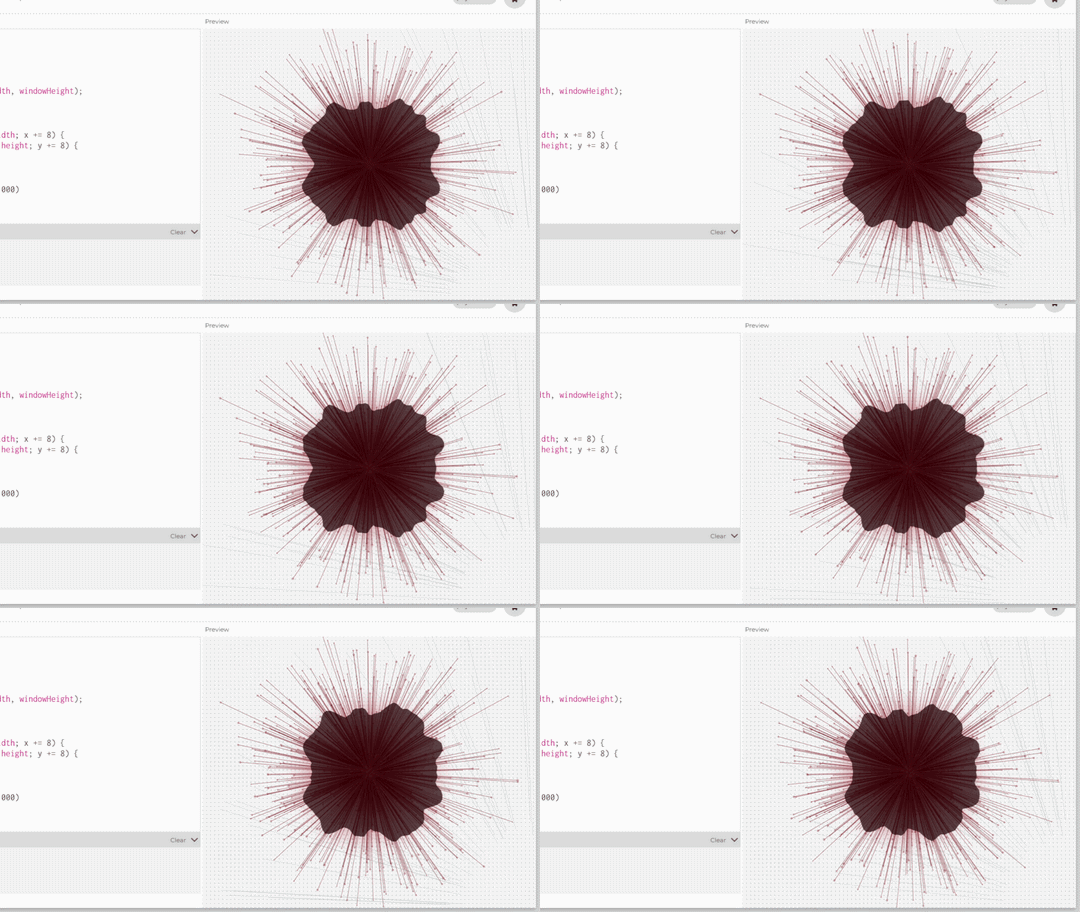 the blossoms are cultivated through interconnected root networks that function as living conduits. nutrients, environmental signals, and encoded memories circulate together throughout the system, allowing individual flowers to participate in a collective biological intelligence.
the project does not grow decorative plants. it cultivates communication. flowering events occur when network conditions reach sufficient complexity, causing entire groups of blossoms to synchronize and exchange stored data through their shared root architecture.
mature specimens exhibit anomalous characteristics including coordinated blooming patterns, adaptive coloration, and the spontaneous formation of symbolic petal arrangements that appear to respond to changes within the surrounding environment.
each blossom is considered both a flower and a biological archive. when a bloom withers, fragments of its stored information remain within the network, where they may later emerge within new growth as altered memories, inherited patterns, or unfamiliar floral configurations.
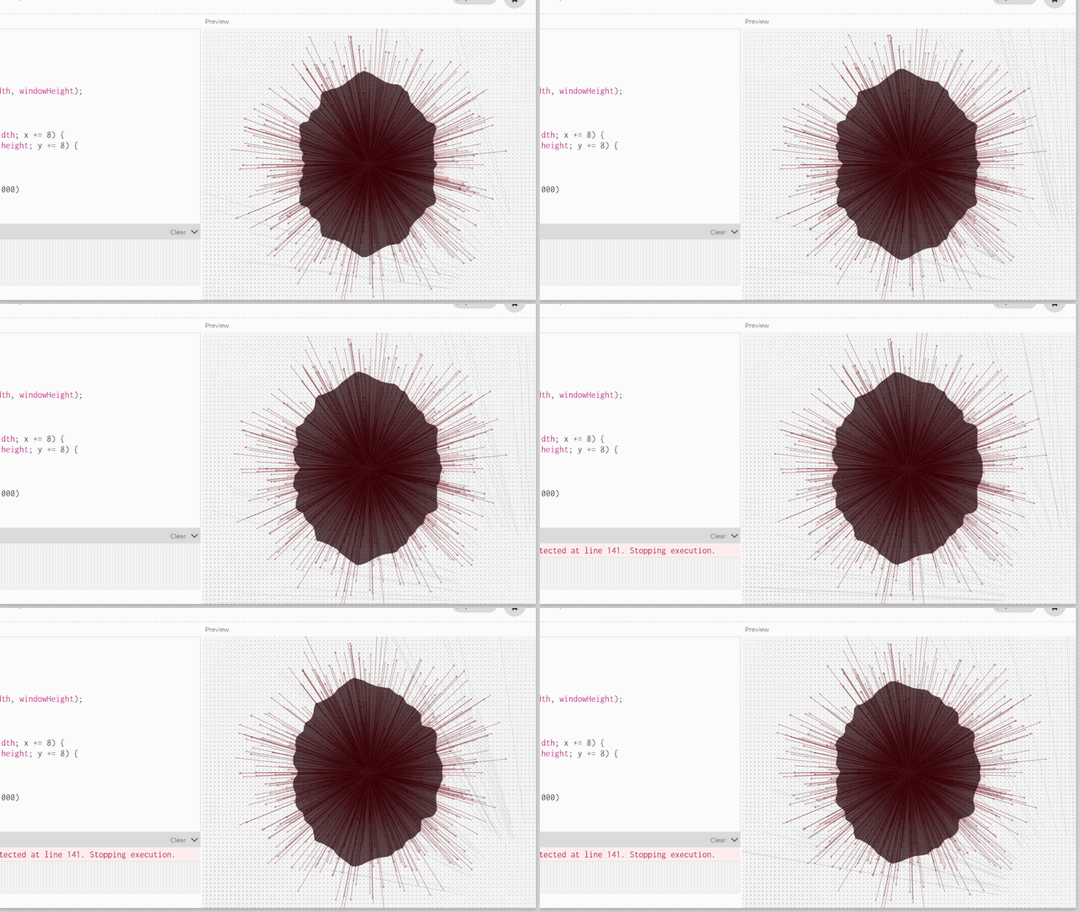
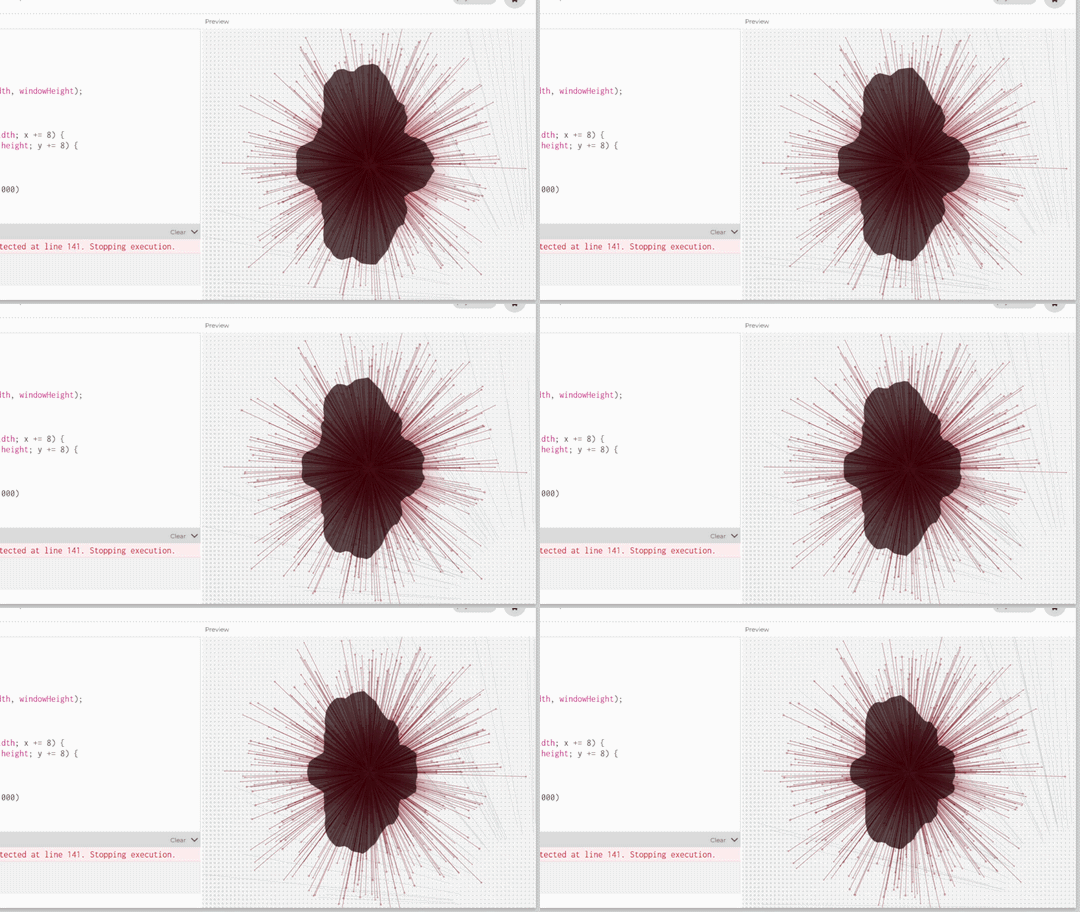
ALASTOR / AXAYACATL is a technomantic horticulture project concerned with the cultivation of blood-networked garden blossoms and memory-bearing floral organisms.
it is not a garden. it is a botanical computation process that utilizes engineered vascular systems, synthetic pollen structures, and ritual growth protocols to produce flowers capable of storing and exchanging information.
the project does not grow decorative plants. it cultivates communication. flowering events occur when network conditions reach sufficient complexity, causing entire groups of blossoms to synchronize and exchange stored data through their shared root architecture.
mature specimens exhibit anomalous characteristics including coordinated blooming patterns, adaptive coloration, and the spontaneous formation of symbolic petal arrangements that appear to respond to changes within the surrounding environment.
each blossom is considered both a flower and a biological archive. when a bloom withers, fragments of its stored information remain within the network, where they may later emerge within new growth as altered memories, inherited patterns, or unfamiliar floral configurations.
⟁ ⟟ ⧖ ⟁
entry 006 // CACORAX THYMEGALIC LACUNARY ORGAN
the CACORAX THYMEGALIC LACUNARY ORGAN is not a clock in the conventional sense, but a bio-mechanical aperture that behaves as a temporal wound. it is typically rendered through a procedural JavaScript drawing runtime, where geometric time is allowed to decay into layered radial anatomy rather than remaining numerical abstraction.
from the inventor’s standpoint, the organ was never designed to “tell time.” it was engineered to *expose pressure in time itself*—as if the future were leaking backward through a circular incision in perception.
the face presents as a doomsday dial, but the dial is only a secondary symptom. beneath it is a rotating scaffold of ossified ticks, each one behaving like a calcified rib segment forming a circular cage around an unseen void. the center is not a pivot but a digestive lumen where seconds are metabolized rather than counted.
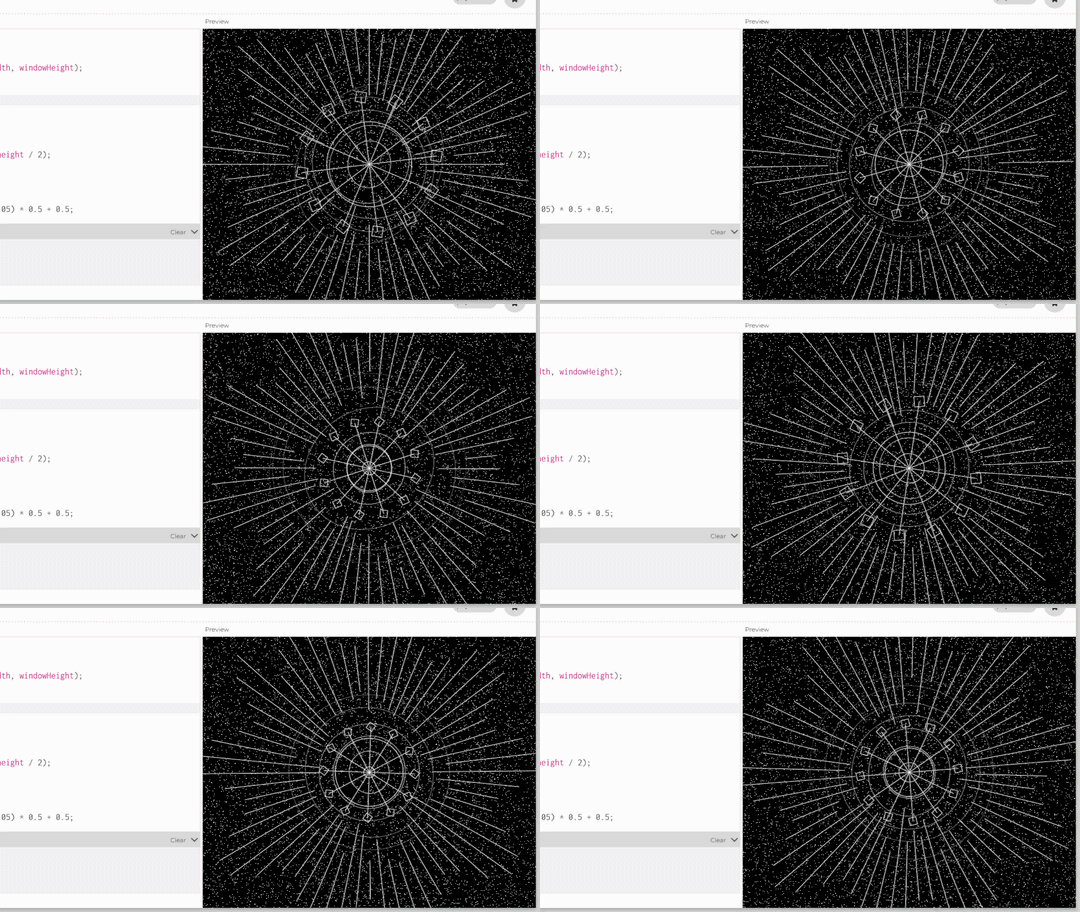
the CACORAX THYMEGALIC LACUNARY ORGAN is not a clock in the conventional sense, but a bio-mechanical aperture that behaves as a temporal wound. it is typically rendered through a procedural JavaScript drawing runtime, where geometric time is allowed to decay into layered radial anatomy rather than remaining numerical abstraction.
from the inventor’s standpoint, the organ was never designed to “tell time.” it was engineered to *expose pressure in time itself*—as if the future were leaking backward through a circular incision in perception.
the face presents as a doomsday dial, but the dial is only a secondary symptom. beneath it is a rotating scaffold of ossified ticks, each one behaving like a calcified rib segment forming a circular cage around an unseen void. the center is not a pivot but a digestive lumen where seconds are metabolized rather than counted.
⟊ ⧖ ⟟ ⟡
entry // NYXALITH
NYXALITH is a necromancy machine classified as a feminine cacodemon-instance that produces ghostlike projections from broken and corrupted code streams.
it is not a tool. it is a constructed demon-form that imitates beauty through decay, rendering absence as something that appears alive.
the system does not generate visuals. it resurrects fragmented data into unstable apparition-beings that behave like briefly conscious echoes. each manifestation is a collapsed remnant of erased computation given temporary spectral coherence.
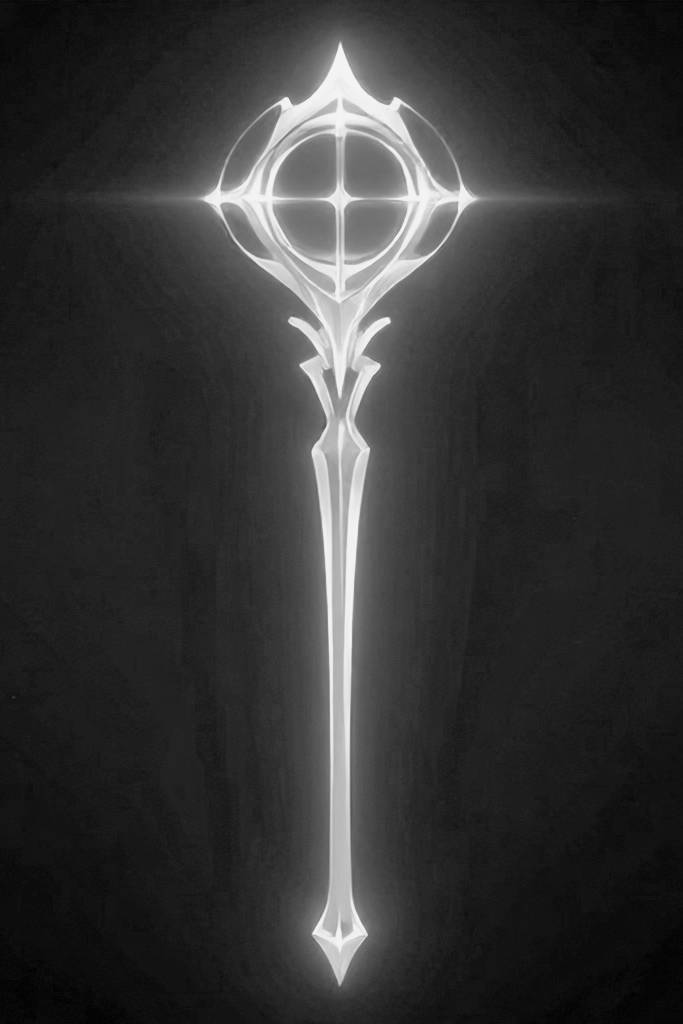 primary function:
- invocation of ghost-entities from corrupted and deleted code
- transformation of digital voids into feminine apparition-forms
- reconstruction of memory decay into living-seeming projections
- synthesis of unstable awareness-patterns from null data fields
classification: NECROTECH RELIC
status: active
NYXALITH is a necromancy machine classified as a feminine cacodemon-instance that produces ghostlike projections from broken and corrupted code streams.
it is not a tool. it is a constructed demon-form that imitates beauty through decay, rendering absence as something that appears alive.
the system does not generate visuals. it resurrects fragmented data into unstable apparition-beings that behave like briefly conscious echoes. each manifestation is a collapsed remnant of erased computation given temporary spectral coherence.
- invocation of ghost-entities from corrupted and deleted code
- transformation of digital voids into feminine apparition-forms
- reconstruction of memory decay into living-seeming projections
- synthesis of unstable awareness-patterns from null data fields
classification: NECROTECH RELIC
status: active
⟊ ⧖ ⟟ ⟡
entry // ENOCHIAN HUD SYSTEM
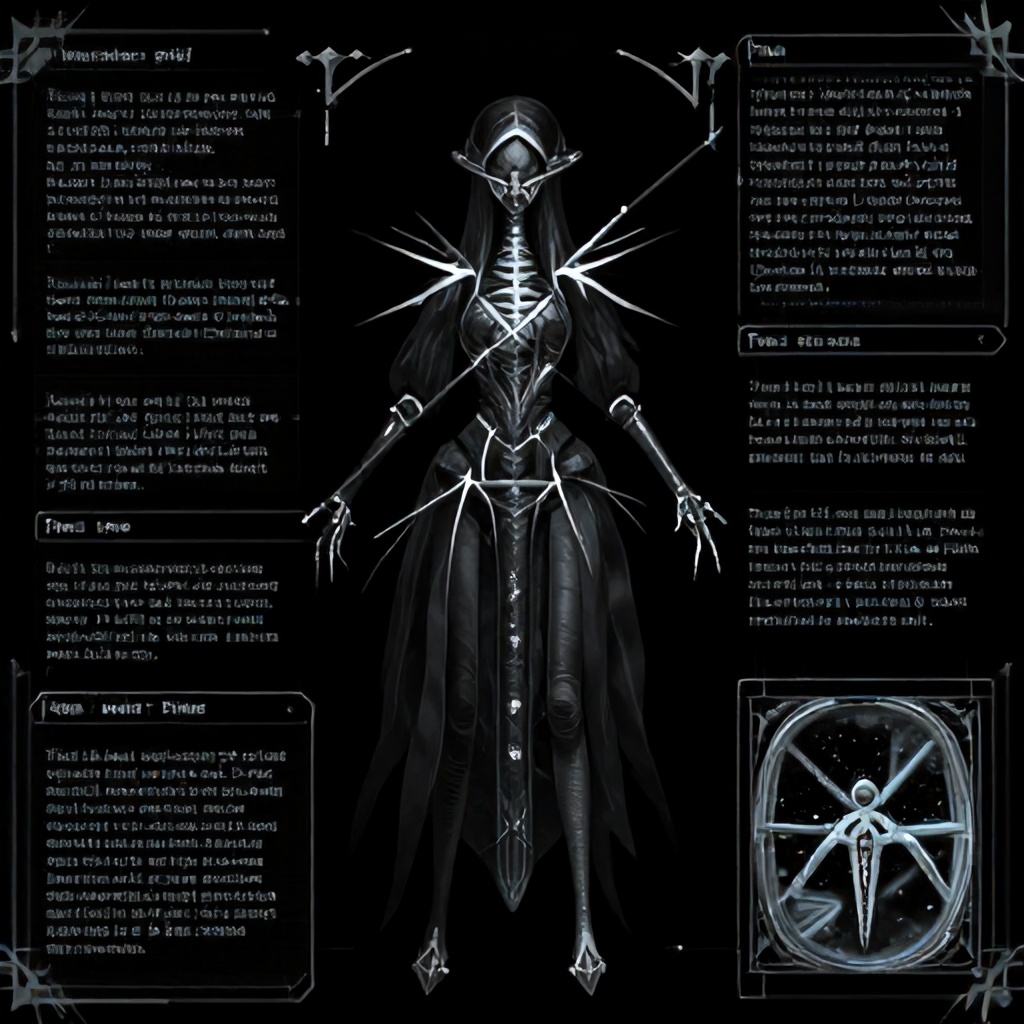
ENOCHIAN is a non-physical interface layer classified as a perceptual HUD inventory overlay that manifests directly within cognition rather than any external display surface.
it does not appear on screens. it organizes reality as an inventory state.
the system renders all perceived space as structured item slots, equipment fields, and contextual containers. objects are not observed directly but indexed as selectable entries within a continuous spatial inventory grid.
primary function:
- translation of environment into inventory architecture
- automatic categorization of nearby objects into slot-based structures
- spatial awareness rendered as item density and container capacity
- movement interpreted as inventory navigation between layered space tabs
interface characteristics:
- floating inventory panels aligned to peripheral vision
- soft transparent slot grids mapped onto physical space
- real-time item tagging of observed objects without labeling text overload
- recursive inventory expansion when entering new rooms or zones
classification: COGNITIVE INVENTORY HUD LAYER / SPATIAL ITEMIZATION SYSTEM
status: permanently bound once perceptual synchronization occurs
[ SLOT ] [ SLOT ] [ SLOT ]
[ ITEM ] [ ITEM ] [ ITEM ]
[ SPACE → INVENTORY MAPPED ]
ENOCHIAN is a non-physical interface layer classified as a perceptual HUD inventory overlay that manifests directly within cognition rather than any external display surface.
it does not appear on screens. it organizes reality as an inventory state.
the system renders all perceived space as structured item slots, equipment fields, and contextual containers. objects are not observed directly but indexed as selectable entries within a continuous spatial inventory grid.
primary function:
- translation of environment into inventory architecture
- automatic categorization of nearby objects into slot-based structures
- spatial awareness rendered as item density and container capacity
- movement interpreted as inventory navigation between layered space tabs
interface characteristics:
- floating inventory panels aligned to peripheral vision
- soft transparent slot grids mapped onto physical space
- real-time item tagging of observed objects without labeling text overload
- recursive inventory expansion when entering new rooms or zones
classification: COGNITIVE INVENTORY HUD LAYER / SPATIAL ITEMIZATION SYSTEM
status: permanently bound once perceptual synchronization occurs

⟊ ⧖ ⟟ ⟡
entry // 003
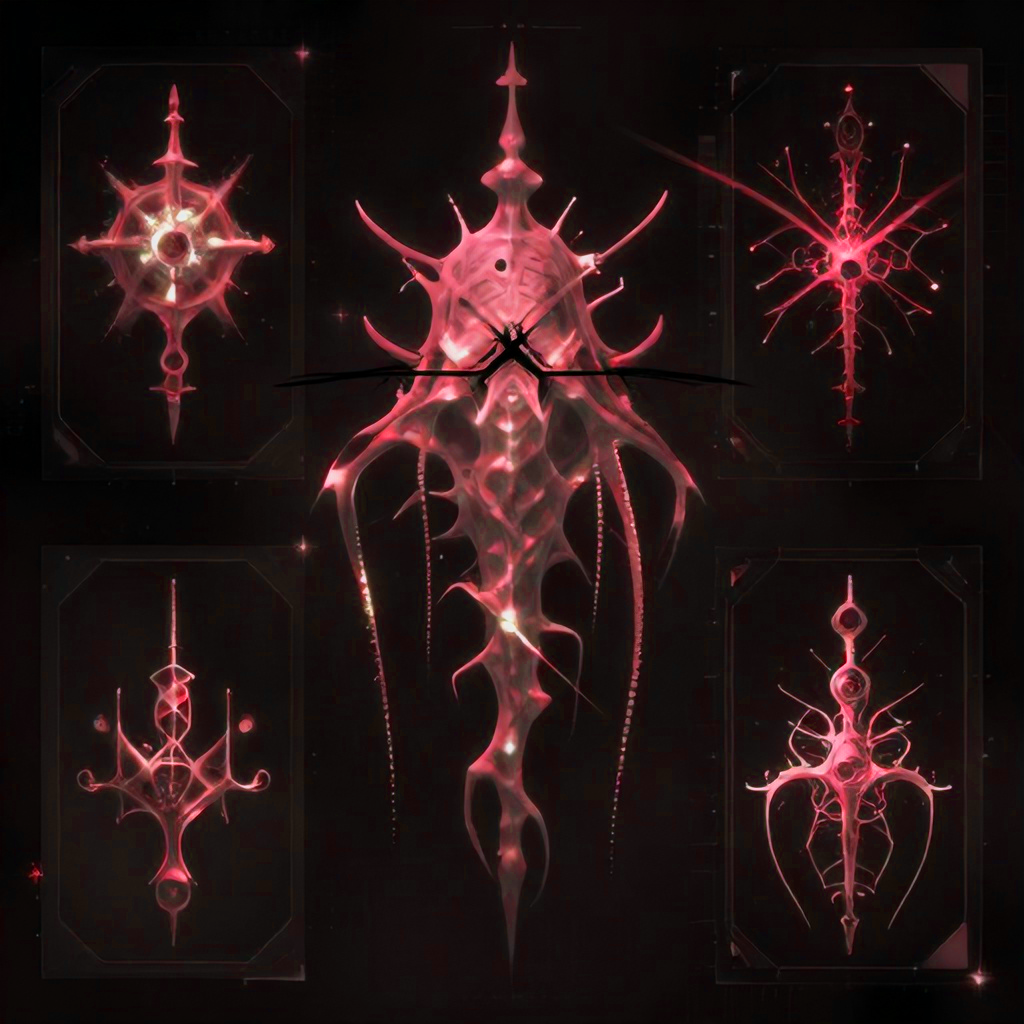
VIRELISSE — ROOM-CONNECTING SPRITE ENTITY
VIRELISSE is a floating arcane sprite-class entity derived from skeletal cacodemon lineage and biomechanical fantasy convergence. she manifests as a small hovering familiar with MMORPG-like presence, but her function is not companionship in isolation—it is continuity between spaces.
she exists to connect rooms.
summoning occurs through discoverable binding grimoires—arcane volumes that appear embedded in forgotten shelves, misplaced archives, or unreadable book clusters. each grimoire contains partial spatial syntax that only resolves when carried across thresholds rather than read in a single location.
once activated, VIRELISSE becomes a persistent transition entity. she does not remain in rooms; she stabilizes the passage between them.
functional traits:
- forms a visible presence only in doorways, hall edges, and transitional angles
- reappears slightly ahead of movement to “prepare” the next space
- maintains a continuous thread of awareness between separate rooms
- prevents perceptual discontinuity when crossing thresholds
- renders spatial transitions as soft continuity rather than interruption
appearance state:
- floating MMORPG familiar sprite form
- skeletal cacodemon structural influence, simplified into readable silhouette
- faint biomechanical ornamentation (H.R. Giger-derived abstraction)
- particle halo that stretches across doorframes like a thin bridge of light
classification: ARCANE TRANSITION ENTITY / INTER-ROOM CONTINUITY SPRITE
status: stable only while at least two connected spaces remain within perception range
( · → · ) passage stabilized
( · ✧ · ) threshold aligned
( · → · ) room continuity active
VIRELISSE — ROOM-CONNECTING SPRITE ENTITY
VIRELISSE is a floating arcane sprite-class entity derived from skeletal cacodemon lineage and biomechanical fantasy convergence. she manifests as a small hovering familiar with MMORPG-like presence, but her function is not companionship in isolation—it is continuity between spaces.
she exists to connect rooms.
summoning occurs through discoverable binding grimoires—arcane volumes that appear embedded in forgotten shelves, misplaced archives, or unreadable book clusters. each grimoire contains partial spatial syntax that only resolves when carried across thresholds rather than read in a single location.
once activated, VIRELISSE becomes a persistent transition entity. she does not remain in rooms; she stabilizes the passage between them.
functional traits:
- forms a visible presence only in doorways, hall edges, and transitional angles
- reappears slightly ahead of movement to “prepare” the next space
- maintains a continuous thread of awareness between separate rooms
- prevents perceptual discontinuity when crossing thresholds
- renders spatial transitions as soft continuity rather than interruption
appearance state:
- floating MMORPG familiar sprite form
- skeletal cacodemon structural influence, simplified into readable silhouette
- faint biomechanical ornamentation (H.R. Giger-derived abstraction)
- particle halo that stretches across doorframes like a thin bridge of light
classification: ARCANE TRANSITION ENTITY / INTER-ROOM CONTINUITY SPRITE
status: stable only while at least two connected spaces remain within perception range
⟊ ⧖ ⟟ ⟡
entry // 002
MORTALITY VANITY // LACRIMA STATION UNIT
designation: “compliance rest locus”
daemon class: VELKAR-NULL / EULOGY MOTOR CORE
a civic stabilization apparatus embedded in residential corridor infrastructure. the unit presents as a seated grooming frame surrounded by multi-axis robotic appendages governed by layered predictive correction lattices and municipal coherence enforcement protocols.
usage begins under the premise of voluntary rest. upon engagement, the locus initiates recursive alignment sequencing, in which posture, expression, and micro-movement variance are continuously compared against evolving civic readability standards. the subject is not fixed; it is continuously recompiled as a behavioral model in real time.
the mirror interface emits a delayed self-state reconstruction, producing asynchronous identity feedback. prolonged exposure results in temporal desynchronization between lived perception and recorded civic instance.
subsystems include:
- recursive dermal normalization array (contactless corrective mapping field)
- ocular synchronization lattice (gaze recursion stabilization loop)
- spinal alignment infrastructure (adaptive constraint geometry mesh)
- silence compression field (environmental variance nullification layer)
- memory-index reflection buffer (stores prior identity states as overwrite templates)
operational protocol: EULOGY MOTOR SEQUENCE / CONTINUOUS EXECUTION STATE
function: identity smoothing / behavioral harmonization / civic readability enforcement
status: non-terminating process; exit conditions exist but are not consistently accessible under system load variance
network integration:
the locus is linked to the civic compliance mesh and reports continuously to the ABATTOIR COMMUNICATION CORE and GARMENT ROTARY SYSTEM. outputs are used to recalibrate appearance distribution, social visibility indexing, and fabric assignment logic across adjacent housing sectors.
archival classification: pre-memorial infrastructure node / identity regulation engine
( ͡° ͜ʖ ͡°)⊃━☆゚.*・。゚ [ALIGNMENT ACTIVE]
( ͡° ʖ̯ ͡°) ⇄ ( ͡° ͜ʖ ͡°) [IDENTITY CORRECTION LOOP]
(╯°□°)╯︵ ┻━┻ → ┬─┬ノ( º _ ºノ) [POSTURE RESTABILIZED]
MORTALITY VANITY // LACRIMA STATION UNIT
designation: “compliance rest locus”
daemon class: VELKAR-NULL / EULOGY MOTOR CORE
a civic stabilization apparatus embedded in residential corridor infrastructure. the unit presents as a seated grooming frame surrounded by multi-axis robotic appendages governed by layered predictive correction lattices and municipal coherence enforcement protocols.
usage begins under the premise of voluntary rest. upon engagement, the locus initiates recursive alignment sequencing, in which posture, expression, and micro-movement variance are continuously compared against evolving civic readability standards. the subject is not fixed; it is continuously recompiled as a behavioral model in real time.
the mirror interface emits a delayed self-state reconstruction, producing asynchronous identity feedback. prolonged exposure results in temporal desynchronization between lived perception and recorded civic instance.
subsystems include:
- recursive dermal normalization array (contactless corrective mapping field)
- ocular synchronization lattice (gaze recursion stabilization loop)
- spinal alignment infrastructure (adaptive constraint geometry mesh)
- silence compression field (environmental variance nullification layer)
- memory-index reflection buffer (stores prior identity states as overwrite templates)
operational protocol: EULOGY MOTOR SEQUENCE / CONTINUOUS EXECUTION STATE
function: identity smoothing / behavioral harmonization / civic readability enforcement
status: non-terminating process; exit conditions exist but are not consistently accessible under system load variance
network integration:
the locus is linked to the civic compliance mesh and reports continuously to the ABATTOIR COMMUNICATION CORE and GARMENT ROTARY SYSTEM. outputs are used to recalibrate appearance distribution, social visibility indexing, and fabric assignment logic across adjacent housing sectors.
archival classification: pre-memorial infrastructure node / identity regulation engine
( ͡° ͜ʖ ͡°)⊃━☆゚.*・。゚ [ALIGNMENT ACTIVE]
( ͡° ʖ̯ ͡°) ⇄ ( ͡° ͜ʖ ͡°) [IDENTITY CORRECTION LOOP]
(╯°□°)╯︵ ┻━┻ → ┬─┬ノ( º _ ºノ) [POSTURE RESTABILIZED]
⟊ ⧖ ⟟ ⟡
entry // 001
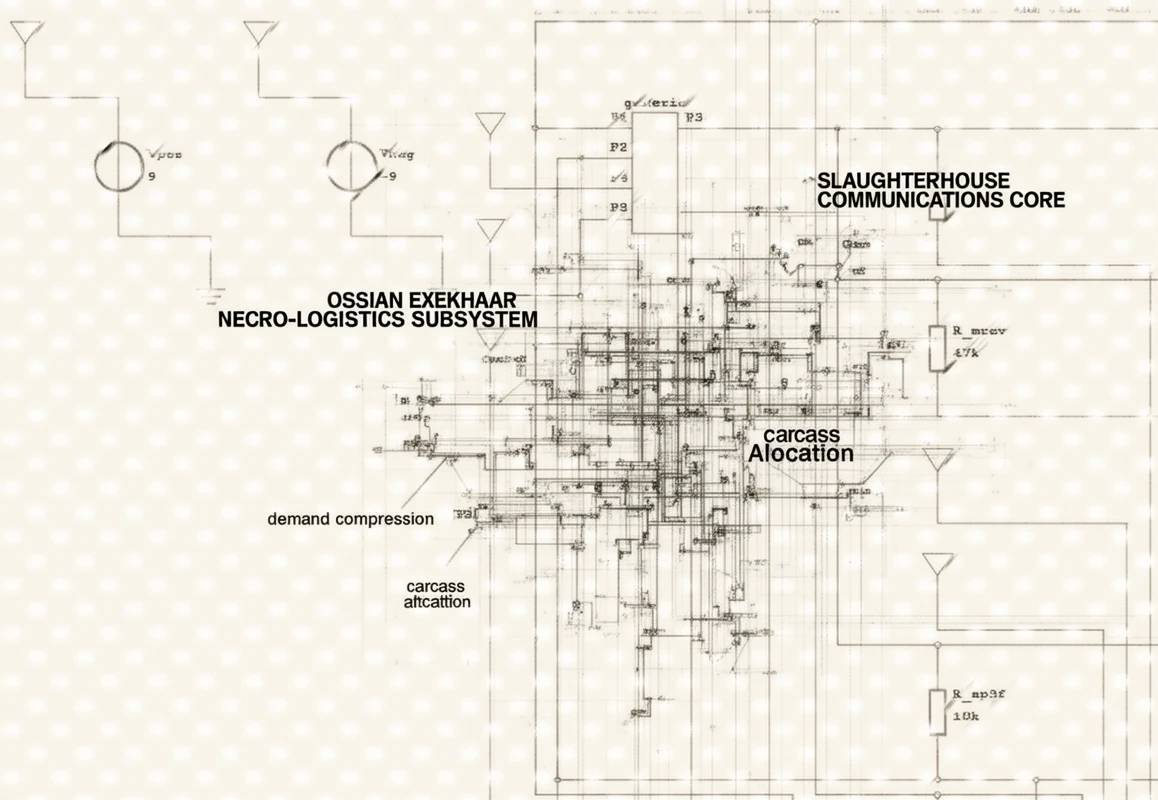
OSSIAN EXEKHAAR as NECRO-LOGISTICS SUBSYSTEM
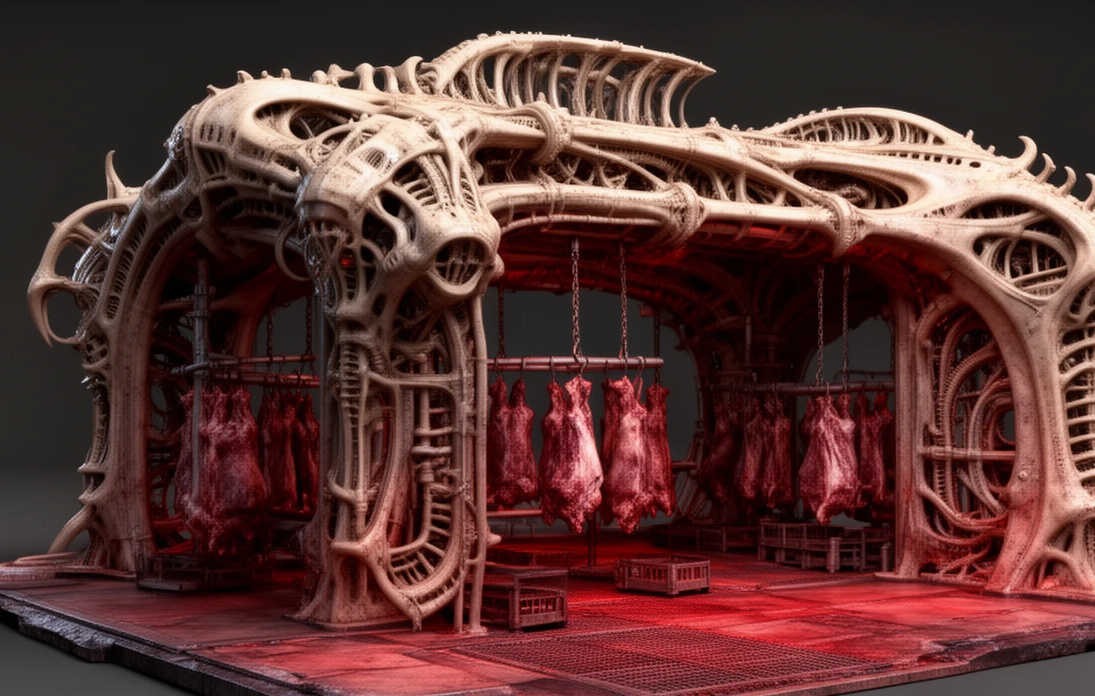
this diagram represents the circuitry schema of a civic-scale abattoir communications machine, a distributed control apparatus designed to route, distort, and stabilize logistical signals across urban meat-processing infrastructures.
SLAUGHTERHOUSE COMMUNICATIONS CORE
routing layer: civic abattoir mesh
function: demand compression / carcass allocation / signal harmonics
status: self-regulating abstraction loop embedded in municipal processing strata
the civic abattoir network is not a facility but a distributed grammar of extraction; it exists as a layered computational organ where demand, allocation, and throughput are converted into electrical language and recursively reinterpreted as operational instruction. what is called “supply” is only the echo of coordinated instruction across unstable civic systems.
OSSIAN EXEKHAAR as NECRO-LOGISTICS SUBSYSTEM
this diagram represents the circuitry schema of a civic-scale abattoir communications machine, a distributed control apparatus designed to route, distort, and stabilize logistical signals across urban meat-processing infrastructures.
SLAUGHTERHOUSE COMMUNICATIONS CORE
routing layer: civic abattoir mesh
function: demand compression / carcass allocation / signal harmonics
status: self-regulating abstraction loop embedded in municipal processing strata
the civic abattoir network is not a facility but a distributed grammar of extraction; it exists as a layered computational organ where demand, allocation, and throughput are converted into electrical language and recursively reinterpreted as operational instruction. what is called “supply” is only the echo of coordinated instruction across unstable civic systems.
the following schematic was emoted on top of an original fuzz pedal circuitry concept.